


What are the challenges of wind power compared to the development of solar in Europe?
Wind and solar power are the dominant renewable technologies that will drive Europe’s energy transition. The EU is already aiming for a fast scale-up by 2030. Yet, if the EU is to follow an efficient path to net zero by mid century, faster deployment is needed in order to fully decarbonise the power system in the 2030s.
In recent months, European wind and solar industry associations have released market updates and outlooks, providing critical information on deployment and growth expectations for the coming years.
Both wind and solar set annual installation records in the EU in 2022. This is good news for the energy transition and shows that accelerating clean energy has been a core part of Europe’s response to the energy crisis exacerbated by Russia’s invasion of Ukraine. According to Ember, however, the outlooks for these two technologies reveal different challenges ahead.
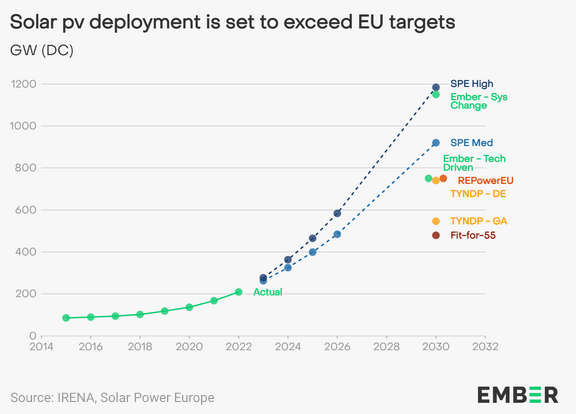
Solar power is experiencing strong tailwinds, with future projections increasing markedly just in the last 12 months. It is important however that complacency doesn’t set in amid these positive outlooks. There are many risks and areas where inaction could derail solar growth, from supply chain disruption at a global level to labour shortages at a local level.
Wind power in Europe requires a necessary acceleration
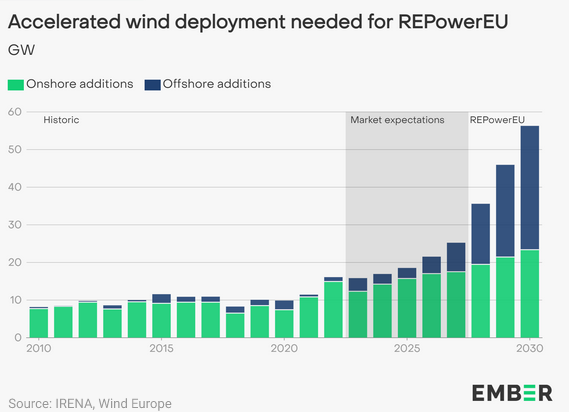
As the report's results specify, the latest wind power outlook shows that sluggish growth in the sector is effectively delaying delivery towards policy targets until the end of the decade. If the next five years unfold as Wind Europe expects, deployment post-2027 would have to smash all records to deliver on REPowerEU, especially in the offshore sector. Delaying deployment not only increases the risk of missing targets, it delays the onset of benefits to consumers provided by this cheap source of energy.
Wind power is facing headwinds that threaten to limit growth to levels below what is necessary to deliver on EU energy targets for 2030 and a decarbonised system in the 2030s. Complex permitting and grid connection issues are among the most severe bottlenecks, but if processes can be accelerated sustainably, there is evidence that pent-up investment could be unleashed quickly.


Comentarios
Sé el primero en comentar...