


Wind and solar expansion drives 20% reduction in EU fossil fuel generation
Clean energy has seen significant growth in the EU since 2019, with wind and solar power increasingly replacing coal and gas. Since the European Commission took office in 2019, the EU’s power sector has undergone major changes, with rapid expansion in wind and solar power leading to a reduction in fossil fuel use and emissions. This trend highlights the EU’s leadership in the global energy transition, supported by ambitious energy and climate policies across Member States.
The EU’s strong commitment to clean electricity, reinforced by the Green Deal in January 2020, has transformed its power sector. According to Ember, since 2019, wind and solar capacity in the EU has surged by 65% (+188 GW). Wind capacity increased by 31% (+52 GW) to reach 219 GW in 2023, while solar capacity more than doubled (+113%) from 120 GW to 257 GW.
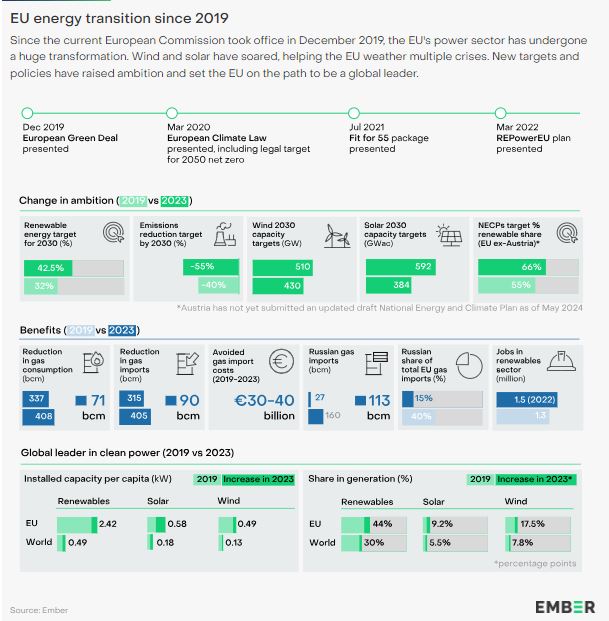
This new wind and solar capacity led to a 46% (+226 TWh) combined increase in generation from 2019 to 2023, raising wind and solar’s share in the EU electricity mix from 17% in 2019 to 27% in 2023. Consequently, the share of total renewables rose from 34% in 2019 to 44% in 2023.
During this period, fossil fuel generation decreased by 22% (-247 TWh), with significant reductions in both coal and gas. Coal generation fell by 25% (-115 TWh) despite a temporary increase in 2021 due to the energy crisis. Gas generation declined for four consecutive years, ending 2023 at its lowest level since 2015, down 21% from 2019 (-120 TWh). This reduction in coal and gas use decreased the share of fossil fuel generation to 32.5%, down from 39% in 2019, and led to an 18% drop in power sector emissions.
The increase in wind and solar generation (+226 TWh, +46%) was sufficient to displace a fifth of the EU’s fossil fuel generation from 2019 to 2023. Without this growth, fossil fuel generation would have only fallen by 1.9% (21 TWh) instead of the substantial 22%.

Wind becomes second largest source of EU electricity
The significant growth in wind power since 2019 resulted in wind surpassing gas generation to become the EU’s second largest source of electricity in 2023. Wind generation increased by 28% (+103 TWh) from 2019 to 2023, reaching a 17.5% share of EU electricity. In 2023, wind produced 470 TWh of electricity, equivalent to France’s total demand, while gas generated 449 TWh.

The clean power revolution spans multiple countries
The transition to wind and solar power is evident across the EU. Germany and Spain led with the largest capacity additions, contributing 42 GW (+38%) and 25 GW (+69%) respectively. Together, they added 35% of the EU’s new capacity. However, significant progress was made across the region, with over half of the 27 Member States at least doubling their wind and solar capacity from 2019 to 2023. Fourteen countries, excluding Germany and Spain, added 74 GW of new capacity, representing 39% of the total EU increase.
Notable growth occurred in Central and Eastern Europe. Hungary added more than 4 GW of new solar, quadrupling its capacity to 6 GW by 2023, while Poland tripled its wind and solar capacity, adding 18 GW and contributing 9% of the EU’s new capacity.

EU maintains global leadership in clean energy
The EU remains a global leader in the clean electricity transition. In 2019, wind and solar made up 17% of the EU’s electricity mix, double the global average of 8%. By 2023, this share had increased to 27%, again double the global average of 13%. In 2023, wind accounted for 17.5% of the EU electricity mix, more than double the global average of 8%, and solar made up 9.2%, nearly double the global average of 5.5%.
Of the 28 countries that installed 1 GW or more of solar capacity in 2023, thirteen were EU Member States. In 2019, only five of these countries had gigawatt-scale markets.
The EU’s electricity mix is among the cleanest in the world, outperforming major economies like the US and China. In 2019, the EU’s electricity generation had an emission intensity of 287 gCO2 per kWh, less than half the global average of 501 gCO2 per kWh. By 2023, the EU had further reduced its emissions intensity by 15%, down to 244 gCO2 per kWh, compared to a global reduction of just 4% over the same period.

Comentarios
Sé el primero en comentar...