


Wind and solar growth helps UK weather rising gas prices
Wind and solar generation in the United Kingdom significantly softened the impact of recent gas price spikes, delivering millions in daily savings during the latest fossil fuel crisis, according to a new analysis by Ember.
The report concludes that the rapid expansion of renewables has helped displace gas-fired generation, reducing exposure to volatile international fossil fuel markets and lowering system costs for electricity consumers.
Renewables cut gas use and reduce costs
According to Ember, wind and solar generation in Britain has played a decisive role in limiting the financial impact of the crisis triggered by geopolitical tensions in the Middle East at the end of February 2026.
The analysis finds that:
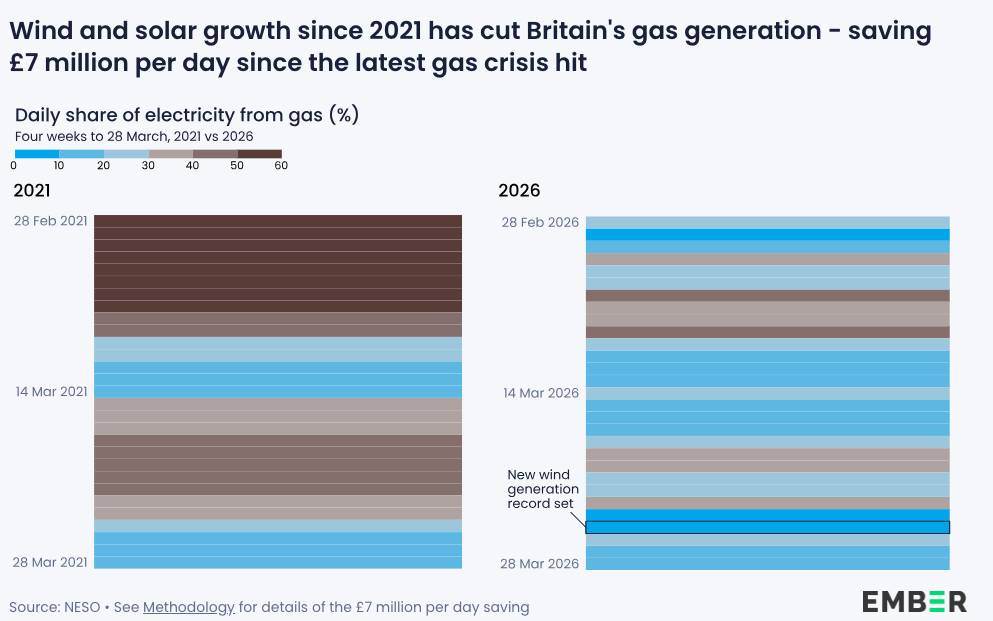
- Wind and solar generation between 28 February and 28 March 2026 was 52% higher than in the same period in 2021.
- Gas-fired generation fell by 39% over the same period.
- This shift enabled an estimated saving of around £7 million per day in gas purchases.
Ember estimates that without the increased contribution from renewables, gas consumption for power generation would have remained at 2021 levels, pushing the cost of gas purchases up by 52% during the first four weeks of the crisis.
Gas prices spike amid geopolitical tensions
The report places the findings in the context of a broader global energy shock following the escalation of conflict in the Middle East, including airstrikes by the US and Israel on Iran on 28 February 2026. The events disrupted global energy markets, contributing to a surge in gas prices in March.
British gas power generation costs rose by 42% during the first four weeks of the crisis, increasing from £77.75/MWh in the week prior to the conflict to £110.42/MWh on average over the period. Wholesale electricity prices peaked at £137.21/MWh on 20 March 2026, the highest daily average recorded so far that year.
Ember notes that while the United Kingdom is not heavily dependent on gas imports from the affected region, it remains exposed to international price fluctuations due to its reliance on global fossil fuel markets for power generation.
Renewables acting as a buffer in the energy system
The report highlights that wind and solar are increasingly acting as a structural buffer against fossil fuel volatility.
During the crisis period, renewables met around 40% of Britain’s electricity demand, while gas fell to 23%. On several days, wind alone supplied more than half of daily electricity demand.
This marks a notable shift from the 2021 energy crisis period, when gas accounted for 38% of electricity generation and the system was significantly more exposed to price shocks.
Ember argues that the continued expansion of renewables has reduced reliance on gas imports for electricity generation, thereby insulating consumers from global fuel price swings.
Expansion of wind and solar capacity
A key factor behind the increased resilience is the rapid build-out of renewable capacity since the previous energy crisis.
According to the report:
- 28% of Britain’s current wind and solar capacity has been added since the 2021–2023 energy crisis began.
- This includes 7.7 GW of new wind capacity and 7.6 GW of solar.
- The country now has close to 55 GW of combined wind and solar capacity.
In total, more than 130 wind and solar projects have been delivered since October 2021, and over 750 projects have either entered construction or received planning approval, representing a potential pipeline of around 60 GW.
Future outlook: further insulation from price shocks
Ember concludes that accelerating the deployment of renewable energy will be key to further reducing Britain’s vulnerability to fossil fuel price volatility.
The report points to government-backed Contracts for Difference (CfD) programmes, under which around 45 GW of wind and solar capacity is expected to be deployed by 2031. It also notes plans to bring forward future auction rounds to secure additional capacity more quickly.
“Ensuring timely delivery of the wind and solar projects in the pipeline will help fortify Britain’s power system against future international fossil fuel price shocks,” the authors state.






Comentarios
Sé el primero en comentar...