
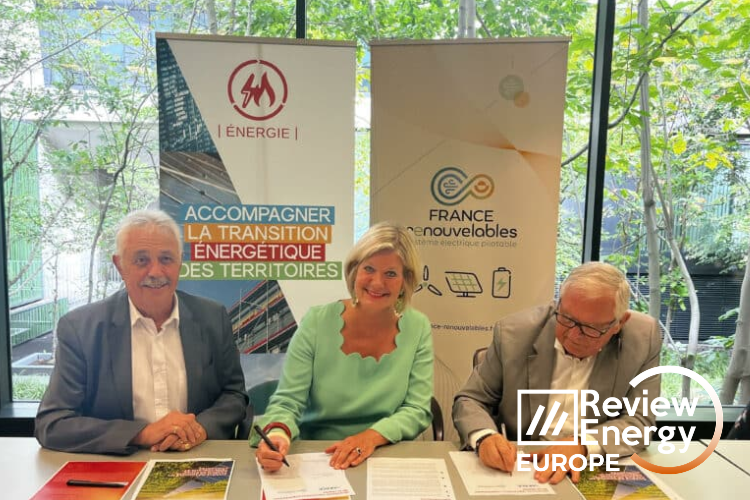


AMORCE and France Renewables sign national charter for concerted agrivoltaic projects
AMORCE and France Renewables have signed a national charter aimed at promoting more locally integrated and concerted agrivoltaic projects in France, following several months of discussions between local authorities, developers and agricultural stakeholders.
The two organisations signed the charter on September 3 and are now calling on local authorities, project developers and agricultural stakeholders to join the initiative and commit to its principles.
The charter comes as agrivoltaics is expected to contribute to France’s ambitious solar deployment targets under the country’s third Multiannual Energy Programme (PPE3). Alongside the development of solar on buildings, car parks, brownfields and degraded land, agrivoltaic projects are expected to play a role in increasing photovoltaic generation while supporting agricultural activity and helping farms adapt to climate change.
However, AMORCE and France Renewables argue that the existing framework established by France’s 2023 Renewable Energy Acceleration Law (APER) does not sufficiently define the role of local authorities in agrivoltaic projects, despite the need for such developments to be integrated into local territories.
Bringing local authorities into projects earlier
The new charter establishes a series of commitments and best practices designed to bring local authorities into project development from the prospecting stage, rather than involving them only at later stages.
It also seeks to ensure that the needs of landowners and agricultural operators are considered, while taking into account the interests of local territories and other stakeholders involved in projects.
The framework covers areas including consultation, transparency and communication, value sharing, governance, agricultural projects and territorial integration, landscape and biodiversity, and local development in both the short and long term.
The charter calls for consultation to begin as early as possible, alongside regular information for elected representatives and local stakeholders.
It also proposes exchanges throughout the life of a project, enabling stakeholders to follow its progress and, where necessary, adapt its implementation to local circumstances.
The organisations behind the initiative want this approach to move beyond simply informing local stakeholders towards collective project development based on transparency, dialogue and joint expertise.
Protecting the agricultural purpose of projects
Agricultural activity remains a central element of the charter. Projects should be consistent with the needs and constraints of the farm concerned and, where relevant, contribute to its long-term resilience.
The charter also states that contractual arrangements between project developers and agricultural operators should provide long-term protection for farming activity.
In addition, where remuneration mechanisms are linked to the use of agricultural land, at least 50% of the total compensation should benefit the agricultural operation, ensuring that the value generated by the project contributes directly to agricultural activity.
Environmental and landscape considerations
The charter calls for landscape and biodiversity considerations to be incorporated from the design stage and throughout project development.
It encourages actions adapted to local conditions and the search for synergies between agricultural production, renewable electricity generation and biodiversity protection.
The framework also calls for decommissioning and end-of-life conditions to be anticipated, ensuring that projects are considered from a long-term perspective.
AMORCE and France Renewables are now calling on local authorities, developers, farmers and agricultural landowners to join the initiative and adopt the shared commitments established by the charter.
The organisations say the objective is to promote agrivoltaic development based on consensus, consultation and joint expertise, with projects capable of generating greater territorial, agricultural, economic, social and environmental value.

Comentarios
Sé el primero en comentar...