


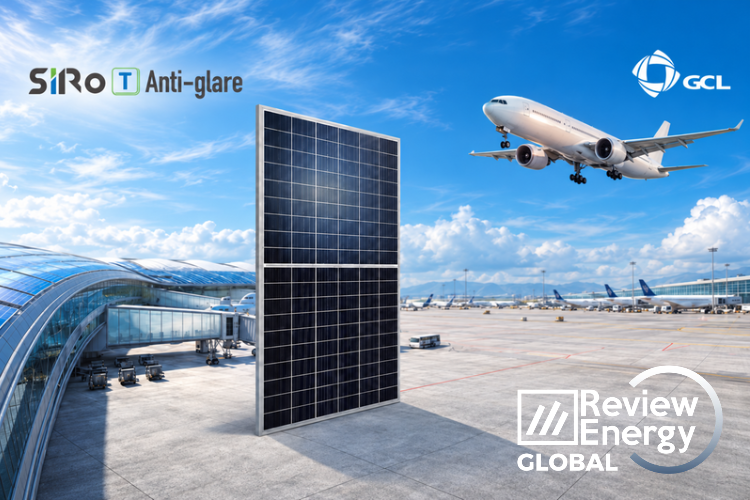


Beyond power output: GCL addresses glare requirements in photovoltaic projects
In certain photovoltaic projects, reflected sunlight can cause discomfort or raise safety, operational and permitting concerns. This is particularly relevant to installations near airports, transportation infrastructure, or residential and commercial buildings.
To address these needs, GCL has focused its efforts on meeting more specific and demanding project requirements, expanding its portfolio with an anti-glare module solution featuring specially etched or treated front glass, designed to reduce strong reflections.
According to the company, potential applications include airports and aviation-related infrastructure, roads, highways, railways and other transportation infrastructure. The solution may also be relevant to installations near buildings where reflected sunlight could cause discomfort, as well as projects where glare is specifically considered during planning or permitting.
GCL is seeing customer interest in this topic, particularly in Europe and Latin America. The company positions anti-glare as an additional project requirement and an emerging application.
Specially treated front glass to reduce glare
GCL uses specially etched or treated front glass to modify the optical behaviour of the glass surface. According to the company, the objective is to reduce strong reflections and, consequently, discomfort glare.
This approach differentiates the solution from standard photovoltaic modules with conventional front glass. The etched glass changes how light interacts with the front glass, with a design that aims to balance glare reduction with high glass transmittance and module energy performance.
TÜV Rheinland Class AAA classification
GCL’s work in this area has led to TÜV Rheinland certification, with a Class AAA result in the discomfort glare evaluation according to 2 PfG 3146. The certificate covers GCL-NT12R/66GDF, GCL-NT12R/54GDF and GCL-NT12R/48GDF configurations within their power ranges.
According to the results shared by the company, the Disability Glare Evaluation recorded a maximum glare luminance of 2,803.71 cd/m²,. The informative Discomfort Glare Evaluation recorded a maximum DGP of 0.29 with which a Class AAA result was achieved.
This classification provides a reference for projects with glare-related requirements. As the company explains, individual project requirements still need to be assessed when considering the modules for a specific airport or infrastructure installation.
NT12R/66GDF: TOPCon technology and up to 620 W
The main product identified by GCL for this solution is the NT12R/66GDF. Its anti-glare datasheet describes an N-type bifacial double-glass TOPCon module, available in power ratings from 600 to 620 W.
The declared module efficiency ranges from 22.2% to 23.0%, depending on the version, under standard test conditions (STC): irradiance of 1,000 W/m², cell temperature of 25°C and air mass of 1.5.
The module features 132 cells, measures 2,382 × 1,134 × 30 mm and weighs 32.5 kg. The datasheet specifies 80 ± 5% bifaciality and a temperature coefficient of Pmax of −0.29%/°C. It also lists a 12-year product warranty and a 30-year linear performance warranty.
Modules tailored to project and environmental requirements
Anti-glare technology is an example of how GCL develops modules according to specific project and environmental requirements, rather than offering only one standard solution.
According to the company, photovoltaic projects increasingly have requirements beyond power output and reliability, including mechanical loads, fire performance, aesthetics, shading conditions and, now, optical and glare requirements.
With this specialised solution, GCL gives customers another module option where reflected sunlight is an important consideration.





Comentarios
Sé el primero en comentar...