


EU biofuel policy faces new challenges ahead of the post-2030 energy framework
El informe de Transport & Environment (T&E) advierte de que los biocombustibles elaborados a partir de cultivos alimentarios y forrajeros podrían ocupar hasta 17.7 million hectares of EU farmland by 2040 if the EU raises the limits on their use in transport. In its analysis of three possible policy scenarios for the post-2030 renewable energy framework, the organisation estimates that this land requirement could reach 18% of the EU’s arable land, while associated emissions would exceed those of fossil fuels by 33 MtCO2e. T&E argues that changes to the current Renewable Energy Directive (RED III) could increase pressure on land use, climate targets and food security.
The report finds that the current RED III cap already allows the EU to use 72% more first-generation biofuels than it consumed in 2024. Even at current consumption levels, emissions from these fuels reach nearly 43 MtCO?e when indirect land-use change (ILUC) is included, around 23% more than the fossil fuels they replace.
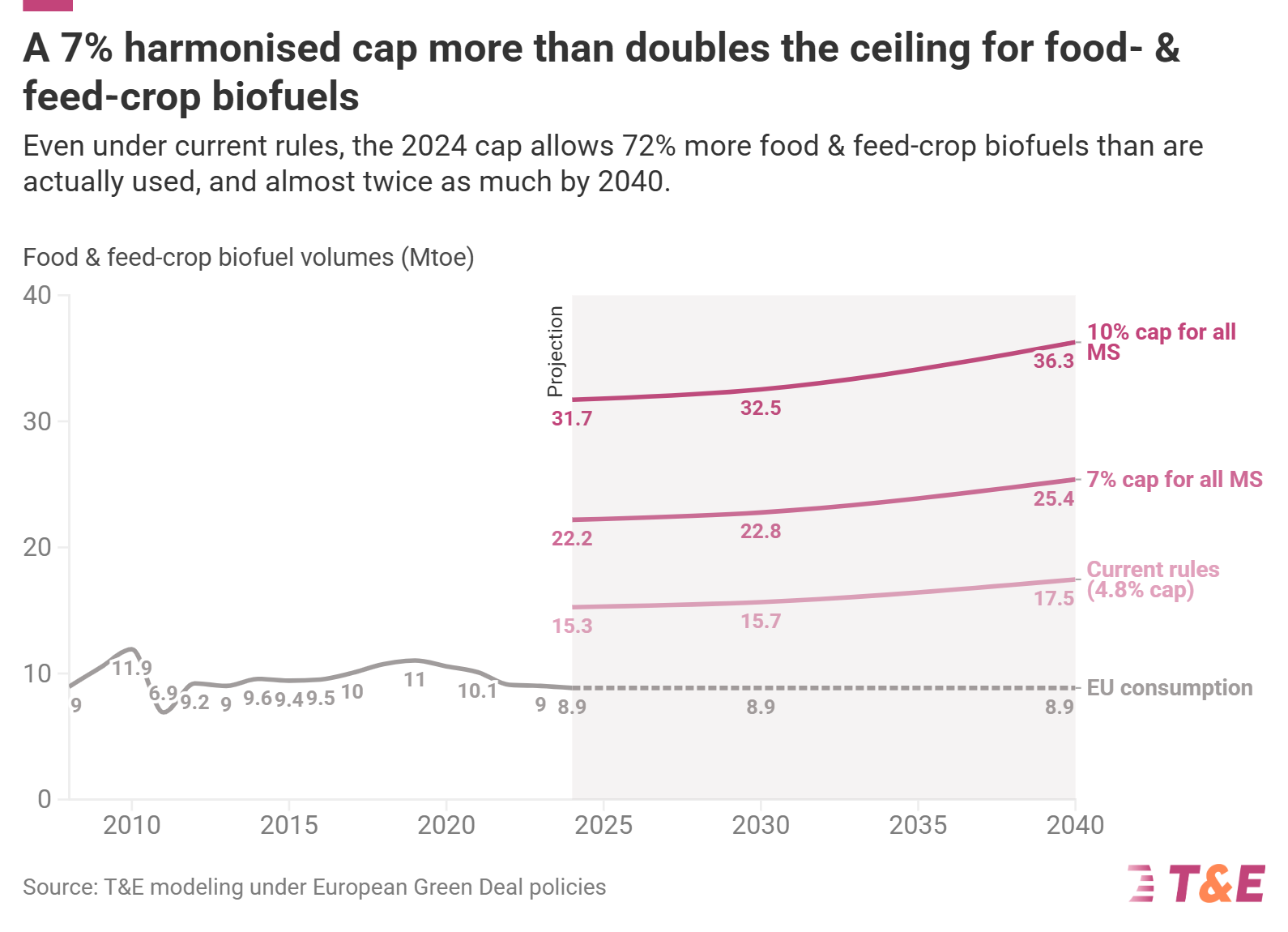
T&E models three scenarios for 2040. Under the current rules, the volume of food- and feed-crop biofuels, land use and emissions could double compared with today. If the cap were harmonised at 7% across all Member States, these impacts could almost triple. In a more adverse scenario, with a uniform 10% cap, volumes, land use and emissions could reach four times current levels, requiring up to 17.7 million hectares of land — an area equivalent to 18% of the EU’s arable land and larger than Greece.
The study also highlights the potential opportunity cost for food production. T&E estimates that the land used to grow feedstocks for EU-produced crop biofuels could have generated up to 27 million tonnes of grain, while warning that expanding their use would increase competition for land, fertilisers, water and food supplies. The organisation also points to the EU’s reliance on imported biofuel feedstocks and fertiliser inputs, arguing that greater use of crop-based fuels would not necessarily strengthen the bloc’s energy independence.
Regarding advanced and waste-based biofuels, T&E says their limited availability means they should be prioritised for sectors that are difficult to electrify, particularly aviation and long-distance shipping, rather than road transport. The report also raises concerns about fraud and mislabelling in imported waste-based biofuels and calls for stronger supply-chain monitoring, improved implementation of the EU’s Union Database and the phase-out of all palm oil-derived feedstocks.
T&E, together with CAN Europe, WWF and more than 30 European renewable industry associations, recommends that the EU maintain the stability of RED III rather than reopen the legislation during negotiations on the post-2030 energy framework. The organisation calls for stricter implementation of existing rules, support for direct electrification and renewable e-fuels, and technical assistance to Member States to improve permitting and grid planning. It also advocates phasing out first-generation biofuels from EU renewable energy targets and introducing an emergency mechanism to suspend their mandated contributions when needed to protect food security.


Comentarios
Sé el primero en comentar...