


Germany sees strong surge in PV self-consumption as new analysis quantifies growth
Self-consumption of electricity from photovoltaic (PV) systems in Germany has risen sharply in recent years, driven by high electricity prices and the growing adoption of storage technologies.
Until 2009, PV system owners in Germany rarely used the electricity they generated themselves, as feed-in tariffs for solar power were higher than the cost of purchasing electricity from the grid. Since then, the balance has shifted, and sector coupling has expanded the ways households and businesses can use their solar energy, making self-consumption increasingly economically attractive.
Researchers at the Fraunhofer Institute for Solar Energy Systems (ISE) have now developed a method to quantify PV self-consumption using data from the Market Master Data Register and transmission system operators. Their findings were published in an analysis for the German Federal Environment Agency.
The study shows that self-consumption rose moderately from 0.25 terawatt-hours (TWh) in 2012 to 3.55 TWh in 2020, reaching 5.57 TWh in 2022. In 2023, self-consumption climbed further to 8.20 TWh, and in 2024 it surged to 12.28 TWh. With net feed-in of nearly 60 TWh, self-consumption now accounts for 17% of Germany’s PV electricity production, up from 13% in 2023.
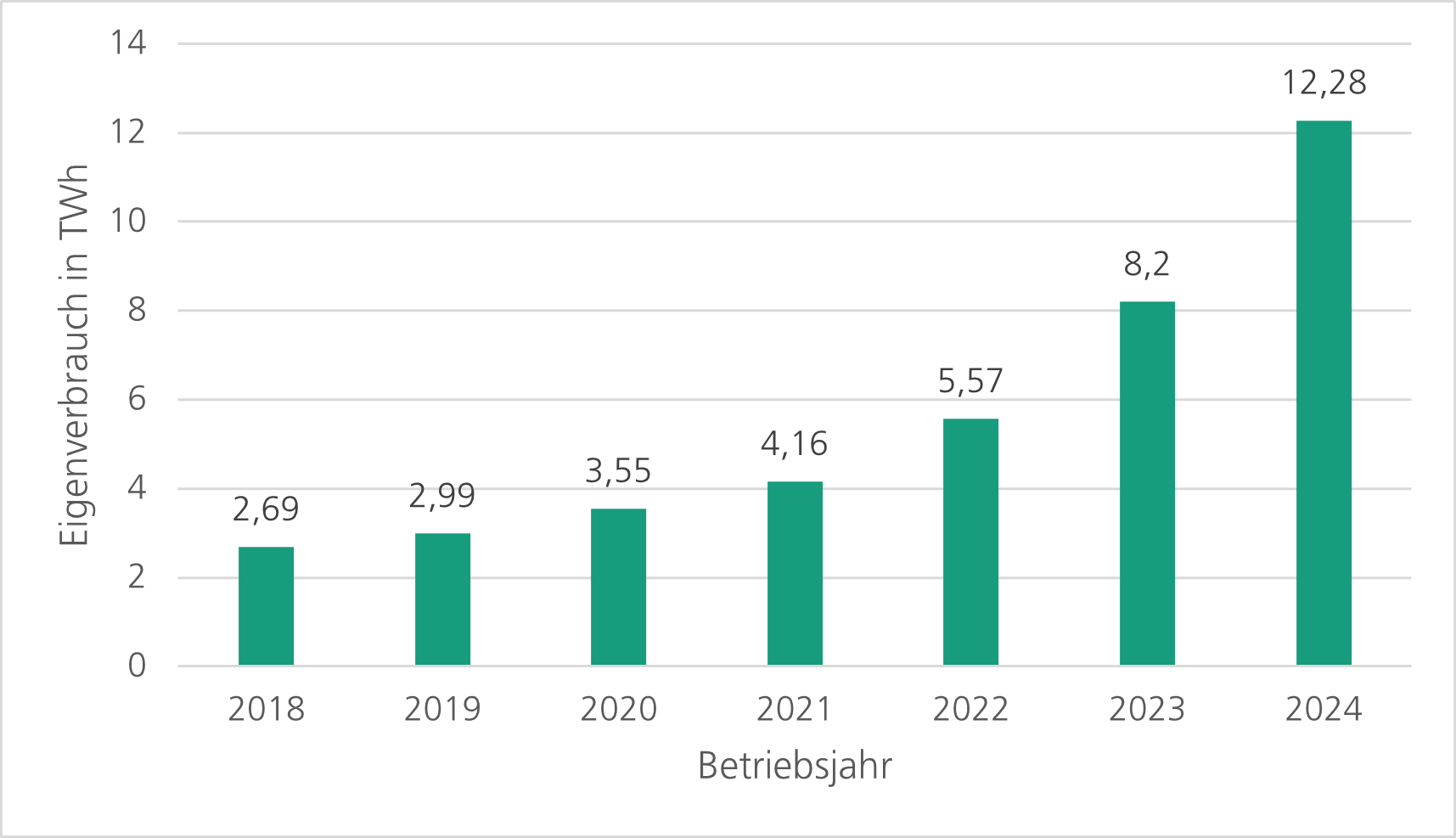
Credit: Fraunhofer ISE
“Self-consumption is expected to continue rising due to high electricity prices and the growing success of battery storage systems,” said Christoph Kost, head of energy system analysis at Fraunhofer ISE. “It is economically attractive for households, especially when the electricity is used to power heat pumps or charge electric vehicles. It also benefits grid stability, as the electricity is consumed where it is generated, without ever entering the transmission network.”
The Fraunhofer team developed their method by categorizing PV installations in Germany by commissioning date, system size, and type, then analyzing feed-in patterns and installed storage systems. This allowed them to estimate self-consumption across 44 different categories.
The full findings, along with detailed PV data, were published in an analysis for the Federal Environment Agency, as part of a series covering eight renewable energy technologies. Another contribution from Fraunhofer ISE examines trends in heat pump adoption.

Comentarios
Sé el primero en comentar...