


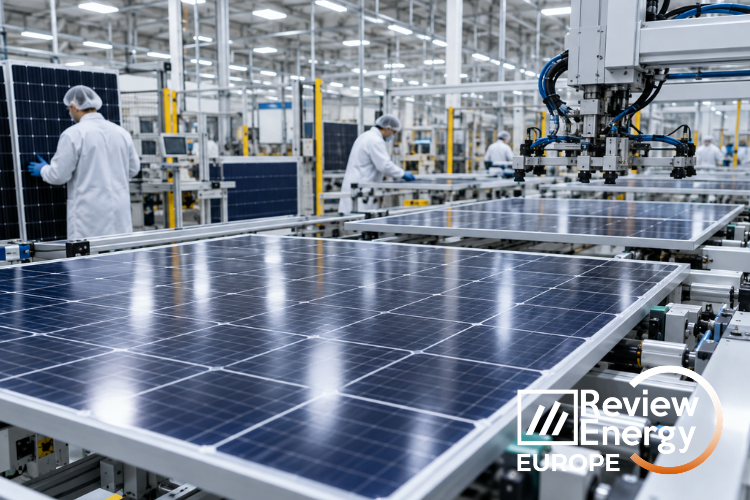


SolarPower Europe warns of slow NZIA rollout to revive European solar PV manufacturing
The European Union’s industrial policy measures aimed at strengthening solar photovoltaic manufacturing are being implemented more slowly than expected, with significant differences emerging between Member States.
That is the conclusion of SolarPower Europe’s Industrial Policy for Solar PV: National Implementation and Progress Report, published on 15 September, which assesses the first national steps to implement the provisions of the Net-Zero Industry Act (NZIA) related to the solar PV industry.
According to the report, although Member States were required to implement the provisions from 1 January 2026, SolarPower Europe has so far identified implementation in only six EU countries.
Beyond the slow rollout, the association points to significant differences in how countries are applying the new rules. Some national approaches impose stricter conditions than SolarPower Europe’s recommendations, which are used as a benchmark in the study, while others fall short of them.
According to the association, these differences are creating a patchwork of national requirements that adds complexity for market participants at a time when the EU is seeking both to accelerate renewable energy deployment and strengthen its domestic solar manufacturing industry.
NZIA aims to stimulate demand for resilient solar supply chains
The Net-Zero Industry Act includes several instruments designed to strengthen European manufacturing of clean technologies. For solar PV, it introduces resilience criteria that can be applied to public procurement, certain support schemes and a share of renewable energy auction capacity.
These criteria are intended to reduce dependence on dominant sources of supply and encourage demand for equipment from more diversified supply chains.
However, the NZIA does not establish general “Made in EU” requirements. Instead, the legislation focuses on resilience and sourcing from non-dominant supply sources.
Specific requirements linked to European manufacturing are currently being negotiated under the forthcoming Industrial Accelerator Act (IAA), which is expected to complement the industrial framework established by the NZIA.
Some Member States have already moved ahead with their own mechanisms. Austria has introduced a 20% “Made in Europe” bonus, while several Italian support schemes have adopted “Made in EU” eligibility criteria, according to the report.
SolarPower Europe calls for more consistent implementation
SolarPower Europe argues that the differences between national approaches could limit the ability of the Single Market to create sufficient demand to support European solar manufacturers.
Anett Ludwig, Head of Supply Chains at SolarPower Europe, said implementation is moving in the right direction but remains too slow, while highlighting the fragmented approach taken by Member States as a particular concern.
Dries Acke, Deputy CEO of SolarPower Europe, said much of the NZIA’s potential remains underutilised and called on the European Commission to ensure that the legislation can be implemented more easily and consistently across the bloc.
The association also argues that demand-side measures alone will not be enough to secure the future of European solar manufacturing.
Among its proposals is the creation of a Cleantech Manufacturing Bank under the European Competitiveness Fund, providing production-linked financial support for clean technology manufacturing.
SolarPower Europe is also calling on the European Commission to establish a repository of national NZIA measures to support a more harmonised implementation approach across Member States.
Impact cannot yet be assessed
The limited progress made so far means that the impact of the measures on European solar manufacturing cannot yet be assessed, according to the report.
SolarPower Europe argues that successful industrial policy will require more consistent and balanced implementation across Member States to take advantage of the scale of the EU Single Market.
The issue is also becoming increasingly relevant as negotiations continue on the Industrial Accelerator Act, which is expected to strengthen the framework established by the NZIA.
SolarPower Europe supports strict “Made in EU” criteria, which it says should not extend beyond the European Union, the European Economic Area, Switzerland and the United Kingdom.
The association said it will continue monitoring national approaches as implementation of the NZIA progresses.

Comentarios
Sé el primero en comentar...