


Battery storage set to be the most affected segment under the US order on Chinese electrical equipment
A White House executive order covering several categories of Chinese-made grid equipment could have a greater impact on battery storage supply chains than on transformers, circuit breakers or inverters, according to a new analysis by Rystad Energy.
Executive Order 14421, signed by President Donald Trump on 26 August 2026, covers substation transformers, grid-connected inverters, battery energy storage systems (BESS), high-voltage circuit breakers and generation turbines.
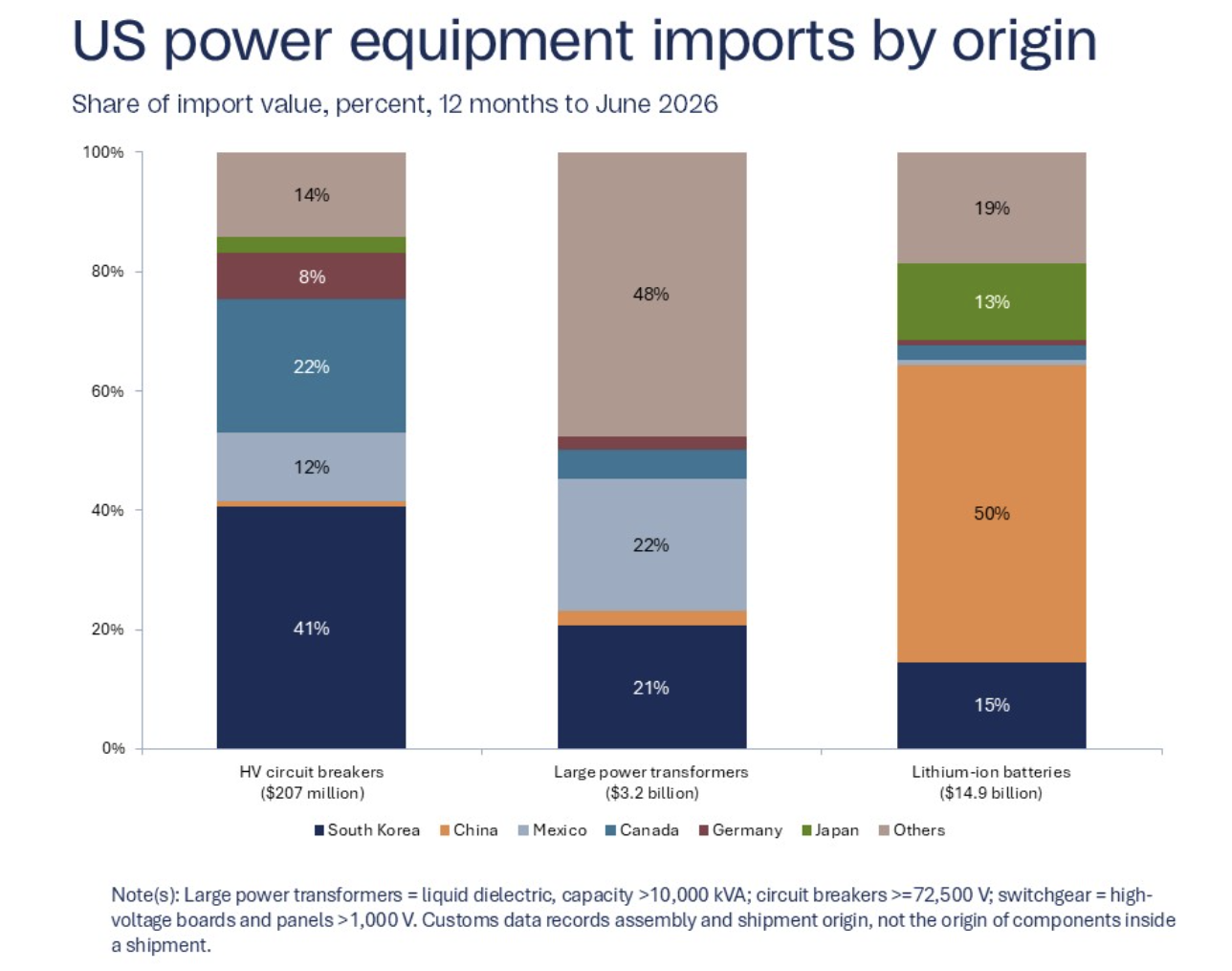
However, Rystad Energy notes that US dependence on China in several of these categories has already fallen significantly. The greatest exposure is now in batteries: China supplied 50% of the value of US lithium-ion battery imports in the 12 months to June 2026.
“The supply chain problem created by the order falls most squarely on battery storage,” said Geoffrey Hebertson, Senior Analyst, Renewables and Power at Rystad Energy.
According to the analyst, transformer and breaker markets had already largely shifted away from Chinese supply before the order was issued, while the battery market has yet to undergo a comparable transition.
Source: Rystad Energy Grid Equipment Analysis; Rystad Energy Solar Solution; Rystad Energy Energy Storage Solution
China accounts for half of US battery imports
Rystad Energy’s analysis shows a significant difference across technologies. China accounted for only around 3% of US transformer imports and less than 1% of high-voltage circuit breaker imports by value in the 12 months to June 2026.
In these categories, South Korea, Mexico and Canada together account for 74% of breaker imports and 48% of transformer imports.
US reliance on China has also declined in the inverter market. The reported value of Chinese inverter exports to the United States fell by 34% between 2022 and 2025, as the 45X advanced manufacturing production credit supported the relocation of inverter assembly to the US.
Rystad Energy expects US inverter manufacturing capacity to reach 126 GW by 2028.
The picture is different for battery storage. After China, the next-largest suppliers of lithium-ion batteries are South Korea, with 15% of US imports, and Japan, with 13%, with no single alternative market currently able to match China’s scale.
Data centers and AI increase exposure
The executive order explicitly links the new security measures to the rapid growth of data centers and artificial intelligence, which are increasing electricity demand and the need for critical power infrastructure.
The measure also covers uninterruptible power supply systems (UPS) used to support critical infrastructure, potentially extending its reach to behind-the-meter battery systems deployed at data centers to ensure power resilience.
For Rystad Energy, this makes battery storage particularly important under the new policy, as large technology companies require growing volumes of storage to support the expansion of their facilities.
December rulemaking will be decisive
The final impact of the order will depend on rulemaking due by 24 December 2026.
One of the main open questions is how the US Department of Energy will define a Covered Foreign Entity. Rystad Energy warns that a broad interpretation could also affect suppliers assembling equipment in countries such as South Korea or Mexico if they rely on Chinese-controlled components, capital or ownership structures.
In that scenario, some of the supply sources currently viewed as alternatives to China could themselves fall under the restrictions.
“If ownership is drawn broadly enough to follow Chinese capital into South Korean or Mexican assembly plants, the supply chain the tech industry is currently relying on to keep AI infrastructure buildout on schedule becomes part of the problem,” Hebertson said.
Rystad Energy therefore considers the December rulemaking the most consequential stage in determining the true scope of the order, particularly for energy storage and the power infrastructure needed to support the expansion of data centers and artificial intelligence.

Comentarios
Sé el primero en comentar...