




Sodium batteries gain ground as an alternative to lithium for energy storage
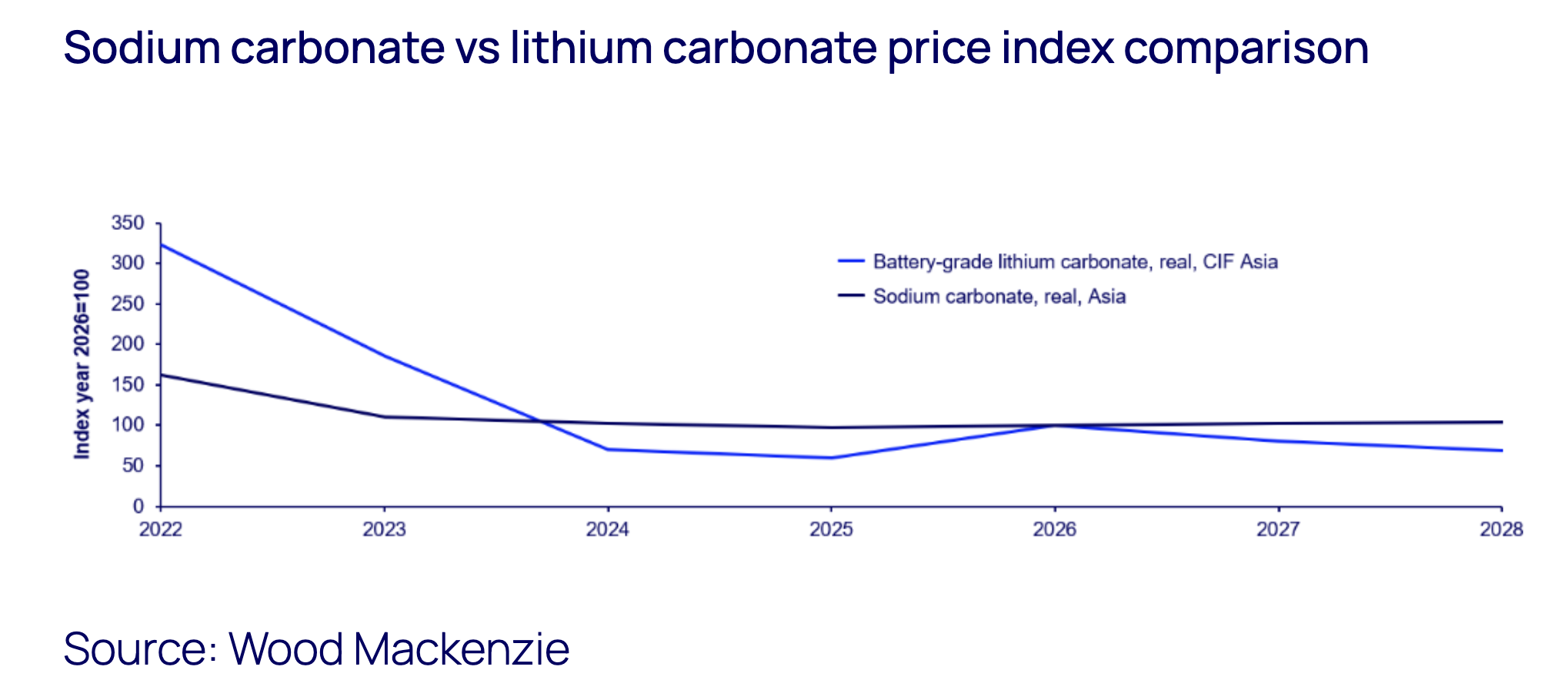
Sodium-ion batteries are moving into commercial production, supported by growing interest in diversified supply chains and reliable performance across a wide range of temperatures, according to new analysis from Wood Mackenzie.
The report, Sodium-ion batteries: commercialisation begins, economics to follow, examines developments in China, the United States, Germany and India. It finds that supply agreements now exceed 70 GWh, signalling growing confidence among downstream customers.
Wood Mackenzie expects leading manufacturers to achieve cell-level cost parity with lithium iron phosphate (LFP) batteries by the end of 2026. However, parity at module and complete system level is not expected until after 2030.
Supply security and temperature performance support adoption
The consultancy identifies supply chain security, cycle life and a broad operating temperature range as key advantages of sodium-ion technology. Its performance in cold conditions strengthens its appeal for applications where low temperatures can affect battery operation.
According to Ankita Chauhan, Director of Global Supply Chain and Integrated Power & Renewables Research at Wood Mackenzie, these characteristics, alongside geopolitical supply advantages, are driving near-term commercialisation.
China leads manufacturing expansion
China is leading the development of sodium-ion manufacturing capacity. Wood Mackenzie reports that BYD has 30 GWh of planned capacity in the country, while CATL is targeting at least 1 GWh of sodium-ion battery shipments by the end of 2026.
China, the United States and Europe have significant offtake agreements, while India remains at an early stage of commercial validation. Manufacturing capacity, however, is expanding ahead of demand.
The consultancy estimates a learning rate of 18–20% for China during 2026–2035, reflecting the potential for costs to decline as production scales and manufacturers gain experience.
Higher upfront investment, lower lifetime costs
The analysis puts average global upfront costs for sodium-ion systems at US$229/kWh, compared with US$200/kWh for LFP. Despite this initial premium, it estimates that sodium-ion can deliver a 21% lower total cost of ownership over a 20-year project.
The projected savings stem from lower operating expenditure and avoiding capacity additions needed to compensate for battery degradation. According to Wood Mackenzie, system economics remain stable across storage durations of two to four hours.
Near-term deployment nevertheless faces several obstacles. The report highlights Chinese export controls, India’s underdeveloped supply chain, slow gigafactory expansion in the United States and German trade policies as potential constraints on growth.
Policy plays a central role in commercialisation
Wood Mackenzie finds that taxation, trade measures and domestic manufacturing incentives are shaping sodium-ion deployment alongside technological progress.
According to the report, China’s reintroduction of a consumption tax on lithium-ion batteries in July 2026 exempts sodium-ion technology through the end of 2028. LFP batteries face a 2% levy from September 2026, rising to 4% from September 2027.
In the United States, the consultancy identifies Section 301 tariffs of approximately 58% on Chinese energy storage cells as an incentive for domestic sodium-ion production, complemented by manufacturing credits under Section 45X of the Inflation Reduction Act.
In Europe, carbon-footprint disclosure requirements under the EU Battery Regulation provide further support. India is developing local capacity through a US$1.25 billion incentive programme and duty exemptions on manufacturing equipment, the report notes.
The economics could shift decisively between 2030 and 2035
Wood Mackenzie identifies 2030–2035 as the period when sodium-ion economics could become significantly more competitive. For projects being deployed today, however, it considers LFP the established, bankable choice for storage assets with durations of two to four hours.
Sodium-ion manufacturers still need to scale production, refine cell materials and establish a consistent operating track record. The consultancy therefore expects several battery technologies to coexist, each serving different applications and storage durations.

Comentarios
Sé el primero en comentar...