
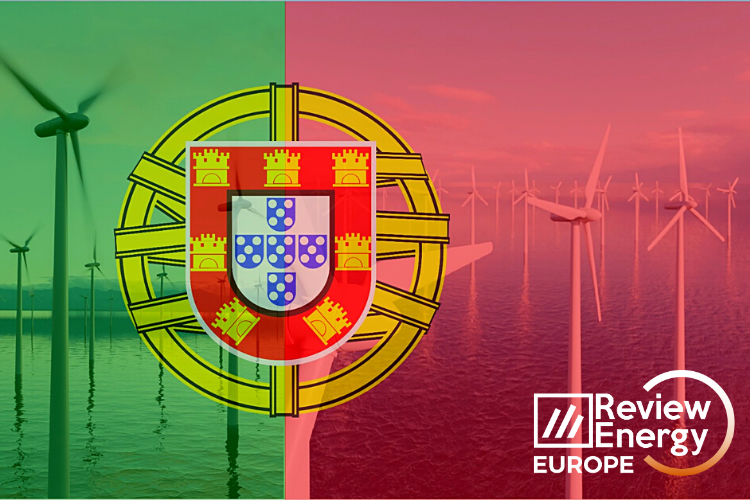


A single-stage auction for offshore wind in Portugal will bring certainty to the market
Portugal is firmly committed to the development of offshore wind as part of its long-term energy strategy. The country has set ambitious targets for renewable energy generation and has set itself the goal of having 80% of its electricity consumption coming from renewable sources by 2026. With a windy climate and a large maritime area, Portugal has opted for this form of renewable energy to diversify its energy matrix and reduce its dependence on fossil fuels.
This commitment is reinforced precisely by the latest update of theNational Energy and Climate Plan 2030 (PNEC). With regard to offshore wind generation, the commitment to launch auctions corresponding to a capacity of 10 GW by 2030 has been reaffirmed, thus reinforcing the stability of the electricity system and attracting the value chain of offshore technologies to Portugal. In fact, the first auction will take place already this year and will allow the installation of at least 2 GW until 2030.
In this way, the auctions are presented as a model to be followed with the first projects, but it is essential that the auctions have the right design and incentives. As could be seen during Energyear Portugal 2023, experts agree that it is essential for the development of offshore wind in Portugal that the auction is a single stage, in order to provide greater security and stability to developers and the market, providing offshore rights, connection rights and operating rights all at once.
This was pointed out by Álvaro de Miguel, Offshore Director of RWE, who stressed that the best model is to have a single-stage auction because, in this same auction, the maritime rights, connection rights and operating aid rights would be granted. "It gives more security. With this, producers know that the project is viable and that they have enough grid space to connect the projects, and that the project is viable from a financial point of view," he added.
At the same time, de Miguel stresses that another advantage relates to time. Instead of having two auctions, there would only be one and that is an advantage in terms of time. "This, combined with security, allows developers to make commitments to the industry and this is one of the key points. These commitments are made earlier and this unlocks the investments needed to develop a supply chain in Portugal. Portugal is at the front of the pack when it comes to offshore wind but, in order for the country to benefit fully, developers need to make firm commitments so that they can unlock the necessary investment," he explained.
For Pablo Alcón, Offshore Director at Capital Energy, the single-stage auction is better because offshore farms will be implemented faster and will increase competitiveness in the market, which translates into a win for the consumer. "We have to have this 2 GW capacity by 2030 and it will not be possible to realise this goal if we have a two-stage auction, because in the end there will not be a competitive environment and, at the end of the day, it will be the consumer who will suffer with prices because of this lack of competitiveness in the market," he said.
Security is one of the key elements of a single-stage auction process, something that Xavier Duault, Investment Manager at Maple Power, also advocated: "This is what we need to have in Portugal, because in order to get this industry going and to open up this offshore wind sector we need to have security, that also has advantages for the state and the taxpayers. We need to be sure and have clarity about the processes and that will help to achieve the goals of the energy transition proposed by the Portuguese government.
This financial stability and security will also help to some extent to avoid speculation, as Íñigo Viani Desplats-Redier, General Manager of Qair Renewables Iberica, argued. "It seems to me that the single auction model allows us to fight speculation and, not least, if we want to promote local industry, security has to be present from the beginning. We cannot be working locally and not know all the variables in the equation," he said.
Giving developers time to analyse risks
De Miguel also alluded to some basic ideas related to this single auction process. First, developers must be given time to conduct research and analysis of the strategic sites needed to assess the risks of the project. "Normally, producers need a year to collect data and do their analysis, but this does not mean that the competitive process cannot start in 2023. You can do it by way of a pre-qualification and later it will be this single auction," he argued.
"We cannot make excuses to support the auction process in two stages, because projects are only viable when all these three rights are granted: there is limited interest in having only a first auction now, attributing seabed rights. It is important having a support scheme, which should protect producers, because there is a great volatility of prices. It is also worth noting that pre-qualified developers will have to carry out research studies of the locations, and this means some costs, which may prevent some developers from participating in the auction," de Miguel developed.
In turn, the RWE executive provides solutions to these challenges. "In my opinion, it makes sense to promote joint analysis studies to share the risk and for the company that wins the auction to bear all these costs. In any case, viable projects need to have the connection, operating aid and the maritime rights granted, and the easiest way is to do it through a single-stage auction," he concluded.


Comentarios
Sé el primero en comentar...