
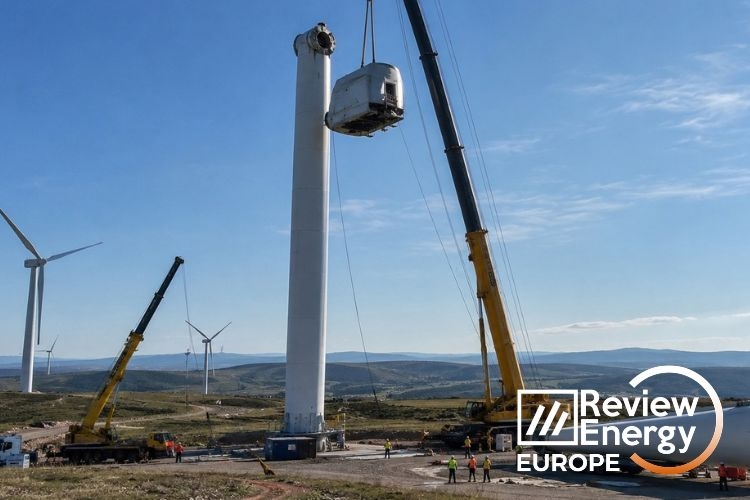


The challenge of building a European end-of-life value chain for wind
Europe is approaching a new phase for its wind fleet, with a growing number of turbines reaching 20 years of operation and facing decisions over lifetime extension, repowering or decommissioning. According to Shoreline Wind’s Triple Jump: Wind’s Repowering Opportunities report, almost 30% of Europe’s installed wind capacity will be approaching 20 years of operation by 2030.
The volume of turbines reaching the end of their operational life will continue to increase, but the industry is not starting from scratch. According to Christoph Zipf, Head of Press & Communications at WindEurope, a growing supply chain of companies is already focused on different stages of the process, from decommissioning and transportation to recycling. Spain is among the leading countries in this field, alongside the Netherlands, Denmark, Germany, Poland and the UK.
“We are confident that this supply chain can grow in line with the projected waste volumes,” the expert told Review Energy.
Repowering, lifetime extension or decommissioning
Repowering is emerging as one of the main options for ageing wind farms, although it will not be viable for every project. For Zipf, it is a “no-regret option” wherever it is technically and economically viable and, crucially, where the project can secure the necessary permits.
WindEurope’s data shows the potential of repowering. On average, repowering reduces the number of turbines in a wind farm by 25%, while more than tripling its output and quadrupling the output per turbine. The result is more electricity generated from fewer turbines, which Zipf says makes projects more efficient and economical.
It can also support public acceptance, as repowered projects can involve fewer, smaller and faster-spinning turbines for local communities to see.
However, repowering will not be the route for every ageing asset. The decision to extend a turbine’s lifetime depends on a range of factors, although turbines are technically often capable of operating beyond their scheduled 20-year lifetime. Zipf notes that turbines more than 30 years old are still operating in Europe today.
The current economic environment is also creating additional incentives to keep turbines running for longer. High electricity prices and the push towards renewables-based electrification are encouraging operators to consider extending the lifetime of assets beyond their initial 20-year operating period.
76 GW of capacity will be 20 years old or more by 2030
The scale of the challenge is reflected in the estimates shared by Zipf. By 2030, 76 GW of wind capacity will have been operating for 20 years or more.
Of this capacity, around 11 GW is expected to be decommissioned. Some 4.6 GW will be taken down for repowering, meaning the existing turbines will be removed and new ones built on the same sites.
Another 6.4 GW will be permanently decommissioned without replacement. Meanwhile, the majority of the capacity — around 65 GW — is expected to continue operating for several more years through lifetime extension.
These assets could undergo lifetime extension assessments and potentially partial replacement of components such as gearboxes or blades.
As a result, while Zipf considers repowering an important and preferred solution where it is possible, lifetime extension is likely to be the most probable route for the majority of turbines aged 20 years or more.
Recycling blades and materials remains a key challenge
The next challenge will be managing the waste generated by this new phase of decommissioning. For Zipf, one of the biggest bottlenecks is the creation of a genuine European market for wind turbine blade recycling.
Part of the problem lies in the EU’s current waste code framework. Much of a wind turbine can already be incorporated into well-established recycling streams, including steel, cement and cables. As a result, wind turbine waste is often simply categorised as construction waste.
Blades and permanent magnets are different. They are harder to recycle, but they also contain more valuable materials, making traceability particularly important.
“The EU must ensure that these blades and magnets are labelled in a way that allows the waste management and end-of-life industry to trace, collect and recycle them,” Zipf said.
A new industrial opportunity around wind farm end-of-life
End-of-life management could therefore become more than a challenge for the wind industry. It could also create a new industrial opportunity around decommissioning, repowering, recycling and lifetime extension.
Zipf’s answer is unequivocal: “Absolutely.”
For that opportunity to materialise, however, companies need greater visibility over future waste volumes. Recycling and waste management companies will only invest in new technologies, sites and staff if they can be confident that sufficient volumes of material will be available for recycling.
This makes the ability to track blade waste particularly important. Better visibility of the volumes reaching the end of their operational life could strengthen the business case for new recycling solutions and help develop a more competitive European end-of-life value chain.
The role of EU regulation
Regulation will be critical in creating the conditions for that market to develop. Zipf points to the upcoming Circular Economy Act and the forthcoming revision of the EU Waste from Electrical and Electronic Equipment (WEEE) framework as an opportunity to establish a more targeted waste code system.
The aim would be to better differentiate certain wind turbine components, particularly those that are more difficult to recycle and contain more valuable materials.
If designed correctly, Zipf argues, the framework could significantly improve the business case for recycling and support more competitive end-of-life solutions across Europe.
Europe’s transition to a new generation of wind farms will therefore not only involve building new turbines. It will also require the industry to manage assets that can continue operating beyond 20 years, projects that will be repowered and a growing volume of equipment that will need to be decommissioned and recycled. According to Zipf, part of the supply chain needed to manage this process is already in place, but it will need to grow alongside the volumes reaching the end of their operational life.

Comentarios
Sé el primero en comentar...