




Europe’s offshore wind sector enters an execution phase with new policy measures
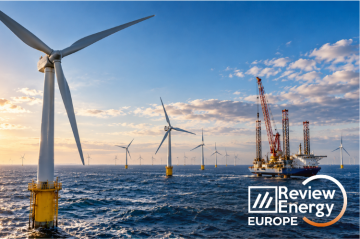
Europe is entering what GlobalData describes as an “offshore wind supremacy phase”, as governments move from setting ambitious targets to implementing policies aimed at securing multi-gigawatt project pipelines. According to the company’s latest Europe Renewable Energy Policy Handbook 2026, redesigned auctions, revenue stabilisation mechanisms and faster permitting are becoming central to the development of the sector.
The report finds that offshore wind is increasingly being treated as strategic infrastructure rather than simply another power generation technology. GlobalData argues that the technology has become one of the few scalable utility-scale renewable sources capable of adding large volumes of low-carbon electricity each year.
Auctions shift beyond price
A key change identified by GlobalData is the redesign of European offshore wind auctions. Governments are increasingly moving towards two-way Contracts for Difference (CfDs) or equivalent revenue stabilisation mechanisms designed to reduce revenue volatility while maintaining price discipline.
Auction frameworks are also placing greater emphasis on whether projects can actually be delivered. New or strengthened provisions cover indexation, project delivery deadlines, non-performance penalties, pre-qualification requirements, and industrial and sustainability criteria.
“The key differentiator is no longer only who offers the lowest price, but who can deliver at scale under permitting limits, supply-chain constraints, and increasingly complex grid integration,” said Attaurrahman Ojindaram Saibasan, Power Analyst at GlobalData.
The company says governments are adapting contract structures, risk allocation for grid connections and pre-qualification requirements to ensure that projects awarded through auctions are realistically capable of reaching construction and operation.
Germany, France and the UK illustrate the shift
Recent European auctions demonstrate the challenges facing offshore wind development. In Germany, an auction held in 2025 for two centrally prepared North Sea sites with a combined capacity of 2.5 GW received no bids. GlobalData attributes the outcome partly to the lack of revenue stabilisation mechanisms such as two-way CfDs, unresolved permitting risks and a mismatch between project timelines and grid readiness.
France, meanwhile, launched a combined offshore wind tender of around 10 GW in mid-2026, divided equally between fixed-bottom and floating projects across its maritime façades. According to GlobalData, the tender reflects both an acceleration of offshore wind deployment and a strategic push towards floating technology.
In the UK, the latest CfD allocation round awarded more than 8 GW of fixed-bottom offshore wind plus floating projects, with strike prices for fixed-bottom developments notably lower, according to the company.
Floating wind moves towards commercialisation
Europe's offshore wind strategy is also expanding beyond conventional fixed-bottom technology. While fixed-bottom projects remain dominant in areas with suitable shallow waters, floating offshore wind is moving from pilot projects towards early commercial deployment.
Several European governments are preparing tenders specifically for floating projects and adapting support mechanisms to account for their higher costs and greater technology risk. The objective is to unlock offshore wind resources in deeper waters that cannot be reached economically with fixed-bottom foundations.
GlobalData sees this development as strategically important because it could expand offshore wind deployment across parts of the Atlantic and Mediterranean. It could also support new industrial activities around floating foundations, mooring systems, dynamic cables, specialised ports and operation and maintenance models.
For investors, however, floating wind currently combines higher near-term risks with potentially larger long-term markets as the technology industrialises and costs decline.
Offshore wind becomes part of wider energy planning
The development of offshore wind is also increasingly being incorporated into broader energy-system planning, rather than being considered solely as a source of electricity generation.
According to GlobalData, emerging policy and market frameworks are linking offshore wind with the electrification of industry, clean hydrogen and e-fuels, as well as cross-border interconnections and balancing mechanisms.
“Offshore wind is now one of Europe’s most consequential renewables battlegrounds not only for decarbonization, but for energy security, industrial competitiveness, and long-term power affordability,” Saibasan said.
GlobalData concludes that the next phase of European offshore wind development will depend on the ability of governments to combine credible auction designs, faster and more transparent permitting, and investable grid infrastructure.


Comentarios
Sé el primero en comentar...