


US has a new strategy to achieve 30 GW of offshore wind by 2030
The US Department of Energy (DOE) released its Offshore Wind Energy Strategy, a summary of the Department's path to meet President Biden's goal of deploying 30 gigawatts (GW) of offshore wind energy by 2030 and putting the country on track for 110 GW or more by 2050.
According to the report, deploying 30 GW of offshore wind would provide enough power for 10 million homes, support 77,000 jobs, and spur $12 billion per year in direct private investment. The Department-wide strategy outlines how DOE will support the Biden-Harris Administration’s whole-of-government approach to accelerate the deployment of offshore wind in support of achieving a carbon-free electricity sector by 2035.
The report sets out four broad outlines for achieving the goal:
• Reducing offshore wind energy costs. The average cost of offshore wind energy generation in the United States is above that of many other generation sources. Additionally, at the time of publication, offshore wind projects are facing challenges associated with rising costs due to inflation and rising cost of capital. Reducing the generation cost is a need for both fixed-bottom and floating offshore wind systems, though reducing that cost is a particular area of emphasis for floating offshore. Floating offshore wind systems are at an earlier commercial and technological stage with costs that tend to be above those of fixed-bottom offshore wind systems.
• Supporting optimized siting and regulation. The extent of lease areas available for offshore wind energy development will need to grow considerably in the coming decades to meet longer-term state and federal deployment goals. Future offshore wind leasing also requires increased certainty in timing and processes, and careful consideration of ocean couse, environmental sustainability, benefits to underserved communities, and energy justice.
• Investing in supply chain development. The nation is readying for its first commercialscale offshore wind energy projects, yet the domestic supply chain is not yet mature enough to manufacture all key components needed to reach the Biden Administration goals, as well as serve global markets.
• Planning the grid integration of offshore wind energy. Most U.S. coastal areas lack adequate transmission capacity to bring gigawatt-scale production from offshore wind turbines to coastal load centers. Therefore, there is a need to deploy offshore and onshore transmission networks to deliver offshore wind power and improve reliability and resilience and to enable dynamic cable solutions for floating offshore wind energy.
DOE says is important to reduce costs from $73 per megawatt-hour (MWh) to $51 per MWh by 2030, develop a domestic supply chain, and inform sustainable, just deployment of fixed-bottom offshore wind.
The Department also notes that in order to move forward, it is important to achieve the Floating Offshore Wind Shot goal of reducing cost by over 70% to $45/MWh by 2035, establish U.S. leadership in floating offshore wind design and manufacturing, and inform sustainable, just deployment of floating offshore wind.
The strategy has to be able to enable reliable and resilient transmission solutions for large-scale offshore wind deployment and to expand offshore wind co-generation technologies for widespread electrification and decarbonization.
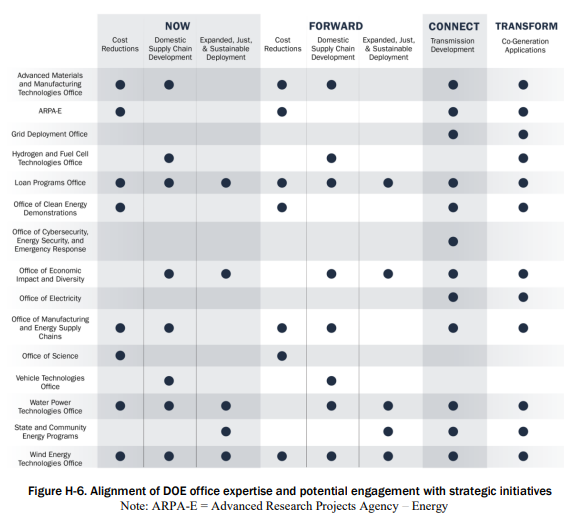
Source: DOE
“The transformative potential of offshore wind energy is critical to achieving President Biden’s bold clean energy goals,” said U.S. Secretary of Energy Jennifer M. Granholm. “As our Offshore Wind Energy Strategy shows, we’re leveraging all resources across our department to harness this clean and reliable American energy source, which will create tens of thousands of good-paying, union jobs and revitalize coastal communities.”



Comentarios
Sé el primero en comentar...