


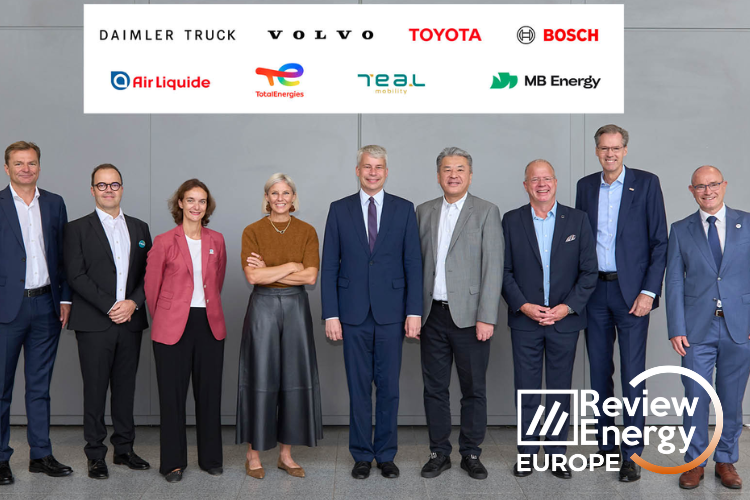


Eight industrial giants launch European push to accelerate hydrogen truck deployment
Eight major companies from the transport, energy and industrial sectors have joined forces to accelerate the deployment of hydrogen-powered heavy-duty mobility in Europe and develop the entire value chain required for its commercial scale-up.
Daimler Truck, Volvo Group, Toyota Motor Corporation, Bosch, Air Liquide, TotalEnergies, TEAL Mobility and MB Energy presented their plans on 15 September at IAA Transportation in Hanover, outlining a coordinated approach covering vehicles, hydrogen supply and refuelling infrastructure.
The initiative uses Germany as the initial market and a model for subsequent expansion across Europe. The companies say the country is creating the conditions needed to enable scalable deployment of hydrogen trucks towards 2030.
The strategy aims to address several of the main barriers that have so far constrained the technology’s development in heavy-duty transport, including vehicle costs, access to competitively priced hydrogen and the limited availability of refuelling infrastructure.
The companies see hydrogen as a complement to battery-electric vehicles, particularly for operations involving long distances, heavy payloads, fast refuelling and high operational flexibility.
Daimler prepares 100 next-generation fuel cell trucks
Daimler Truck has already accumulated around 600,000 kilometres of testing and customer operations with fuel cell trucks.
As a next step, the manufacturer plans to deploy a small series of 100 next-generation fuel cell trucks in customer operations from the end of 2026.
The company is also preparing its first trucks equipped with hydrogen combustion engines for market launch next year and plans to invest several hundred million euros in hydrogen vehicles through the end of the decade.
Volvo Group is also developing both fuel cell and hydrogen combustion solutions, targeting commercial introduction towards 2030.
Toyota will contribute its fuel cell technology expertise, while Bosch will provide components for vehicles using gaseous hydrogen as well as refuelling technologies for both liquid and gaseous hydrogen.
Refuelling stations capable of serving up to 100 trucks a day
Vehicle deployment will be accompanied by investment in infrastructure and hydrogen supply.
Air Liquide, TotalEnergies, MB Energy and TEAL Mobility are working with vehicle manufacturers to expand liquid and gaseous hydrogen supply chains and develop high-capacity refuelling stations.
The projects are moving towards facilities capable of refuelling up to 100 trucks per day, a scale the companies consider necessary to support commercial heavy-duty fleets.
The strategy also envisages deploying stations along strategic European transport corridors in coordination with new vehicle fleets, seeking to ensure that infrastructure and truck deployment develop in parallel.
More than 70 stations and 800 trucks proposed in Germany
The companies point to Germany as the starting point due to the combination of public support and industrial projects already under development.
Recent applications under Germany’s NOW programme were oversubscribed and included proposals for more than 70 high-capacity hydrogen refuelling stations and 800 heavy-duty trucks, according to the companies.
The German approach seeks to address three factors simultaneously: lowering truck acquisition costs through incentives and industrial scale-up; achieving hydrogen prices that can compete with diesel through more efficient supply chains and regulatory mechanisms; and providing operating incentives for transport companies, including road toll exemptions for zero-emission vehicles.
The companies argue that achieving a total cost of ownership competitive with diesel trucks will be critical to encouraging fleet operators to adopt hydrogen technology.
Industry seeks to extend the model across Europe
Following the initial deployment in Germany, the companies aim to use the model as a reference for developing similar ecosystems in other European markets.
They are calling for coordinated action from national governments and the European Commission, particularly to align support programmes for vehicles and hydrogen refuelling stations.
The initiative also calls for further infrastructure deployment to meet the objectives of the Alternative Fuels Infrastructure Regulation (AFIR) and for measures to improve the economic competitiveness of hydrogen.
The strategy also seeks to reduce financial risks across the entire value chain, from hydrogen production and liquefaction to distribution, refuelling and use in heavy-duty vehicles.
Ultimately, the companies aim to create a market in which hydrogen production, refuelling infrastructure and heavy-duty fleets can scale simultaneously, using Germany as the starting point for broader deployment across Europe.



Comentarios
Sé el primero en comentar...