




Europe needs up to €60 billion to close its hydrogen gap by 2030
Hydrogen Europe’s Clean Hydrogen Monitor 2026 counts 677 MW of operational water electrolysis capacity and 3.7 GW under construction, but warns that Europe still needs an additional 25-30 GW and around €50-60 billion in electrolyser investment to meet expected regulatory demand by 2030.
Europe continues to expand its clean hydrogen production capacity, but the current pace remains insufficient to meet the regulatory demand expected by the end of the decade, according to Hydrogen Europe’s Clean Hydrogen Monitor 2026.
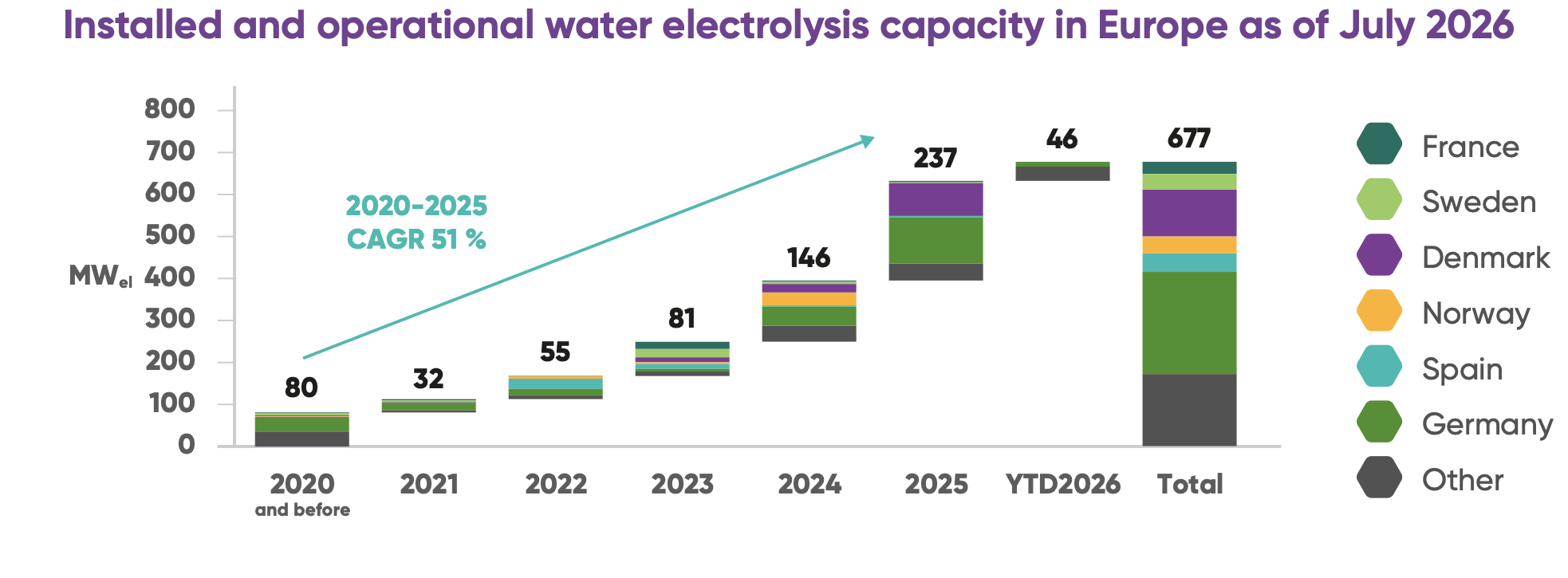
Operational water electrolysis capacity reached 677 MW by July 2026, up 19% from 571 MW a year earlier. Around 3.7 GW of electrolytic hydrogen capacity is currently under construction across Europe.
Hydrogen Europe estimates that the existing operational capacity corresponds to roughly 0.1 million tonnes per year of hydrogen production capacity, equivalent to about 1% of total hydrogen demand in 2025.
78% of capacity under construction is concentrated in five countries
The expansion remains concentrated in a limited number of markets. Around 78% of post-FID electrolysis capacity is located in Germany, Sweden, Spain, the Netherlands and France.
Germany leads Europe with around 1.3 GW under construction, followed by Sweden with 0.8 GW.
Spain has also emerged as one of the leading markets in 2026, with around 0.4 GW reaching final investment decision in the first half of the year, mainly targeting refinery decarbonisation.
Among the Spanish projects highlighted in the report are the 300 MW Onuba project, led by Moeve as the first phase of the Andalusian Green Hydrogen Valley, and the 100 MW Basque Hydrogen Corridor project at Repsol’s Muskiz refinery.
Hydrogen Europe’s Clean Hydrogen Monitor 2026
Refineries and clean steel dominate demand from projects under construction
Projects currently under construction are largely focused on hard-to-abate industrial sectors.
Refining accounts for 54% of planned end-use demand, while clean steel represents 31%.
Hydrogen Europe notes that refining remains one of the most established routes for renewable hydrogen deployment, supported by RED III obligations and its relative suitability for regulatory compliance.
Around 1.6 GW of electrolyser capacity currently under construction is expected to come online in 2026, including several projects above 100 MW.
Europe still needs up to 30 GW of additional electrolysis
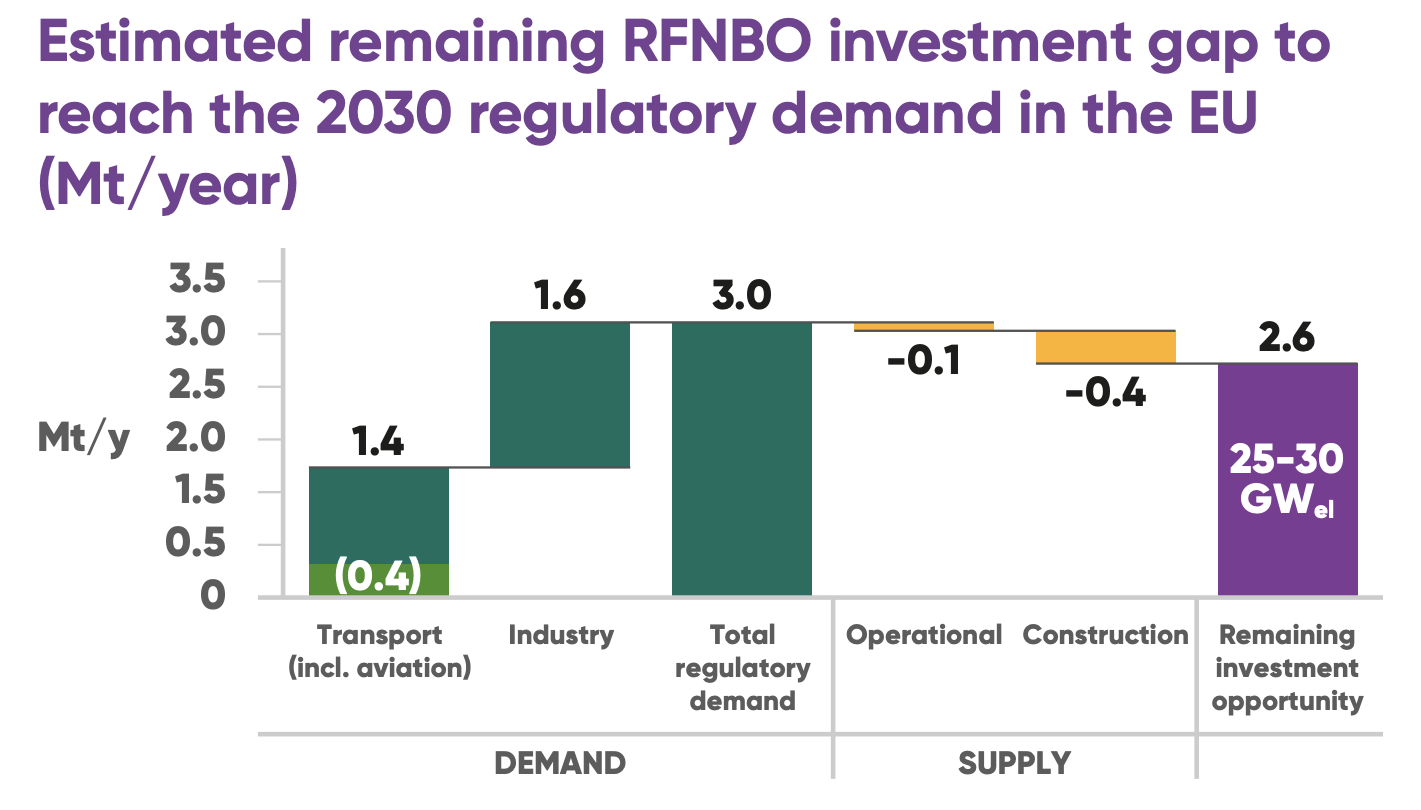
Despite the growing pipeline, Hydrogen Europe estimates that regulatory demand for RFNBO hydrogen could reach around 3 million tonnes per year by 2030.
Projects already in operation and under construction account for only around 0.43 million tonnes per year, leaving a gap of approximately 2.6 million tonnes.
To close that gap, Europe would need to develop an additional 25-30 GW of electrolysis capacity.
The association estimates that this would require around €50-60 billion in new electrolyser investment reaching final investment decision over the next 12 to 24 months.
This figure does not include additional investment required for renewable power generation, e-fuel synthesis, storage, transport infrastructure, ports or refuelling stations.
 Hydrogen Europe’s Clean Hydrogen Monitor 2026
Spain shows one of Europe’s largest project pipelines
The report also identifies a significant mismatch between where future hydrogen demand is expected to emerge and where projects are being developed.
Spain and Finland together have a 14.8 GW project pipeline, compared with around 3.1 GW of policy-driven domestic needs, pointing to a potential surplus and reinforcing the importance of cross-border hydrogen trade and infrastructure.
By contrast, countries such as Poland and Belgium face much larger gaps between projected needs and domestic project pipelines.
Grid costs are becoming a major competitiveness issue
Hydrogen Europe warns that falling technology costs alone will not be enough if electricity network charges continue to rise.
Grid fees, taxes and levies are becoming an increasingly important component of electrolytic hydrogen production costs and vary sharply between countries.
The estimated impact ranges from around €0.15/kg in France, where electrolysers benefit from reduced tariffs and taxes, to €5.3/kg in Poland, where network costs can make electrolytic hydrogen production economically unviable.
Spain is among the countries that have introduced reduced network-related costs for electrolysers.
The cost gap with fossil-based hydrogen narrowed in 2025
The report also points to an improvement in the competitiveness of renewable hydrogen.
In 2025, the average production cost gap between fossil-based hydrogen and electrolytic hydrogen narrowed to around €1/kg, supported by higher gas prices, lower electrolyser CAPEX and cheaper renewable electricity.
In Europe’s most competitive locations, renewable hydrogen produced with a direct renewable power connection fell to around €3.9/kg.
However, Hydrogen Europe warns that grid charges can still account for roughly one quarter of production costs for a typical grid-connected renewable hydrogen project, offsetting part of the gains achieved through lower technology costs.
RED III remains critical for investment certainty
Hydrogen Europe says the transposition of RED III is progressing but remains uneven across Member States.
The report estimates regulatory RFNBO demand at 3 Mt per year by 2030, including around 1.4 Mt from transport and 1.6 Mt from industry.
The association argues that maintaining clear and binding demand signals will be essential to mobilise investment and allow the sector to scale up over the coming years.


Comentarios
Sé el primero en comentar...