


Terna and Snam project 82.3 GW of solar and 124.7 GW of renewables in Italy by 2030
Terna and Snam expect Italy’s solar capacity to expand significantly over the coming years, reaching 82.3 GW by 2030 and between 114.4 GW and 136.7 GW by 2040, according to the new 2026 Scenario Description Document (SDD 2026).
The report, which will serve as a reference for future electricity and gas network planning, updates Italy’s outlook for power demand, renewables, storage and conventional generation for 2030, 2035 and 2040. For 2030, the operators developed a single Best Estimate scenario, while two different pathways are considered for 2035 and 2040: Energy Integration and Power Development.
Under the 2030 central scenario, total installed renewable capacity would reach around 124.7 GW, up from about 80 GW in 2025. Solar capacity would rise from approximately 44 GW to 82.3 GW, while wind would increase from 14 GW to around 20.2 GW. Together, solar and wind would total about 102.5 GW.
Solar outlook revised higher
The SDD 2026 raises the solar outlook compared with the 2024 edition. For 2030, the previous document projected between 70.6 GW and 79.3 GW of solar capacity, while the new Best Estimate reaches 82.3 GW.
The upward revision becomes more pronounced over the longer term. By 2040, Terna and Snam project solar capacity at 114.4 GW under Energy Integration and 136.7 GW under Power Development. The upper end of the previous 2024 outlook was around 121 GW.
Solar generation is expected to reach 110 TWh in 2030, up from 44 TWh in 2025, making it the largest renewable source by output within a total renewable generation forecast of 212 TWh.
Renewables would cover around 63% of Italy’s electricity demand in 2030, with total demand estimated at 338 TWh.
Offshore wind outlook revised down before 2030
The new scenario is more cautious on wind deployment in the short term.
Terna and Snam do not expect any offshore wind capacity to be operational by 2030, compared with between 1.2 GW and 2.1 GW considered in the 2024 SDD. The operators link this revision to the current maturity of projects and the timelines required for permitting and construction.
Offshore wind deployment is expected to accelerate later. By 2040, the Energy Integration scenario includes 1.9 GW of offshore wind, while Power Development raises the figure to 11.6 GW. Under the latter pathway, total wind capacity would reach 45.7 GW.
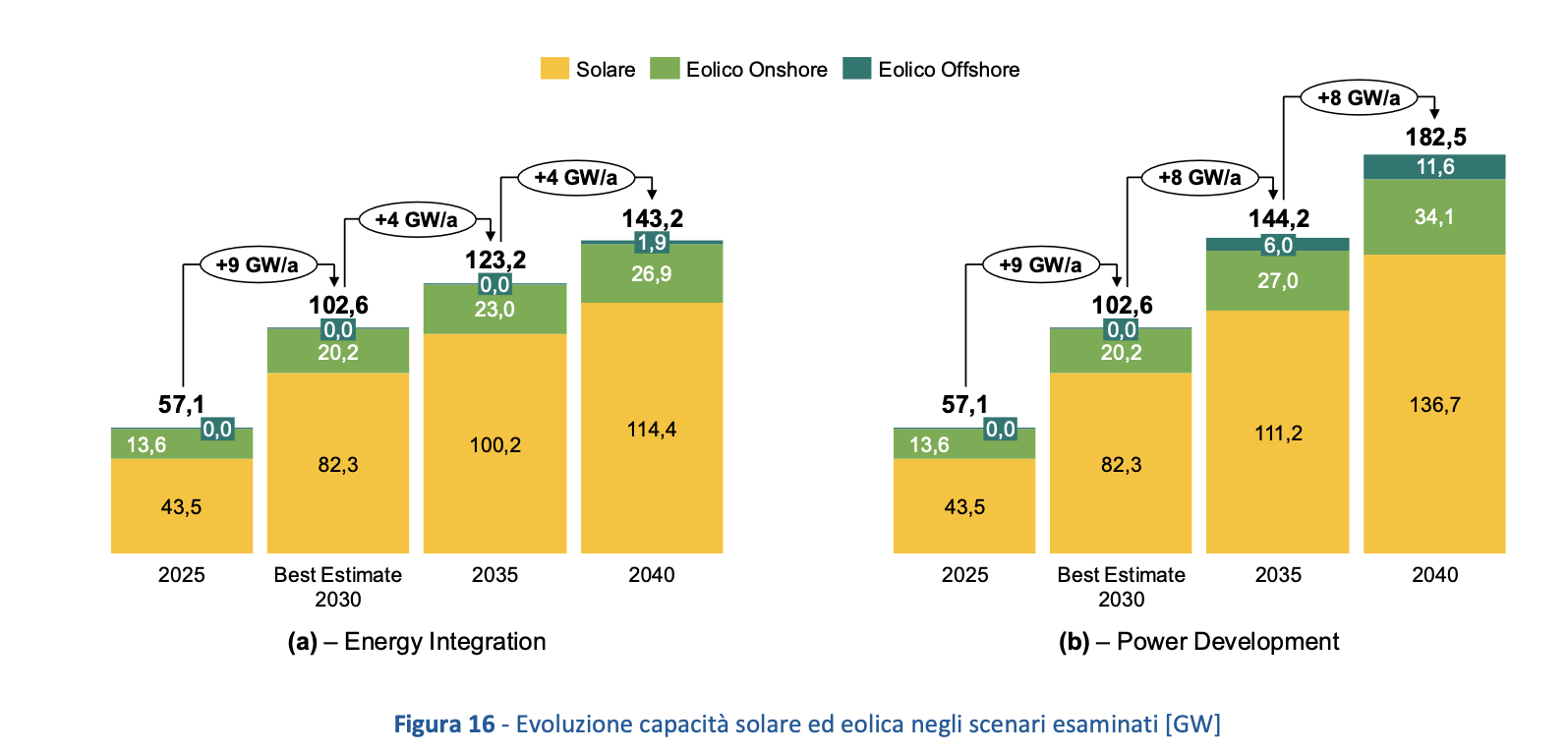
Source: Terna and Snam
Storage to expand alongside renewables
The expansion of solar and wind will also require a significant increase in energy storage capacity.
The SDD 2026 puts total storage energy capacity at 130 GWh in 2030, including existing pumped hydro, compared with around 68 GWh in 2025. By 2040, storage capacity could reach 167 GWh under Energy Integration and 219 GWh under Power Development.
Terna and Snam warn that higher renewable generation will increase periods of excess electricity production, particularly during the middle of the day when solar output is high and demand can be relatively low.
The report indicates that curtailment could become structural in future scenarios if storage, exports and other system flexibility options are insufficient. Storage systems are expected to play a key role by absorbing surplus renewable generation and shifting it to periods of lower output.
Two pathways towards 2040
Under the Energy Integration scenario, renewable deployment slows compared with recent years, with around 4 GW of additional solar and wind capacity per year between 2030 and 2040. Renewables would cover approximately 68% of electricity demand by 2040.
Under Power Development, electrification progresses more rapidly and renewable deployment rises to about 8 GW per year, allowing renewables to supply around 77% of electricity demand in 2040.
Total renewable capacity would reach 165.3 GW under Energy Integration and 204.6 GW under Power Development, compared with 124.7 GW expected in 2030.
The SDD 2026 will serve as a reference for Italy’s upcoming electricity and gas network development plans and will also inform the country’s contribution to the next European TYNDP 2028 scenarios.


Comentarios
Sé el primero en comentar...