




Astronergy celebrates 20 years and accelerates its growth strategy in Latin America
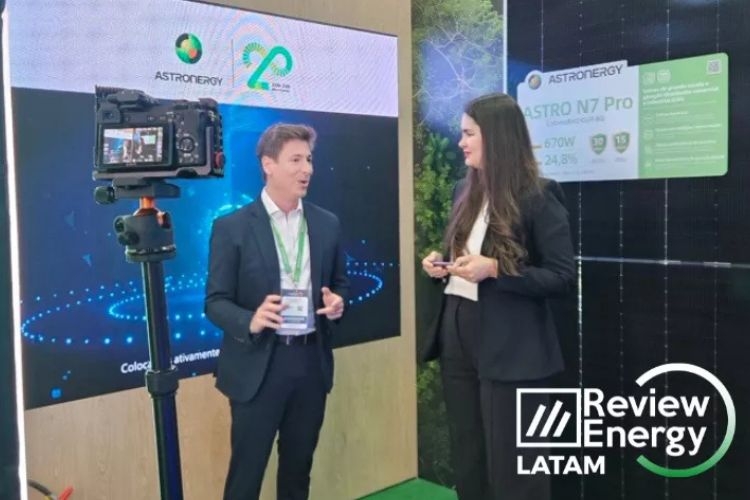
During Intersolar South America 2026, Review Energy spoke with Matheus Cerutti, Head of LATAM Sales at Astronergy, about the company's evolution, the technologies it is incorporating into its portfolio and its next objectives for Latin America.
Astronergy's participation in the São Paulo trade show also had a special significance for the company, which this year is celebrating 20 years of global presence. Two decades during which, according to Cerutti, one of the main challenges has been adapting to an industry that has changed at considerable speed.
“The biggest challenge was keeping up with a market that changed so much and so quickly over these 20 years,” Cerutti says. During this period, the industry has gone through different generations of technology, periods of strong growth, phases of overcapacity and major transformations in the supply chain associated with module manufacturing.
In response to these changes, Astronergy's strategy for Latin America is based on combining the experience accumulated over these two decades with a strong local presence across the region.
“Our strategy for Latin America is to have the strength of a manufacturer, the reliability of a global scale and a 20-year track record, while at the same time being present locally, close to our partners, our customers and our market in every country in the region,” he explains.
More power and efficiency for different applications
This combination of global scale and adaptation to local needs is also reflected in the portfolio presented at Intersolar South America.
Among the main new products showcased was the ASTRO N7 Pro family, based on TOPCon 5.0+ technology, an evolution of Astronergy's TOPCon platform that incorporates several improvements at the cell level to increase module performance.
According to Cerutti, this evolution makes it possible to maintain similar dimensions while increasing power density.
“We are bringing more efficiency, more technology and more confidence to these products,” he says.
The company also presented the 760 W ASTRO N8 Pro in São Paulo, primarily aimed at larger-scale projects. The module is designed for ground-mounted applications, both fixed-structure and tracker projects, where higher power and energy density can help optimise land use and the overall performance of solar installations.
For Astronergy, however, module development should not be assessed solely in terms of rated power.
The diversity of applications across Latin America requires, according to Cerutti, different solutions for each type of project, ranging from residential rooftop installations to commercial and industrial projects and large utility-scale plants.
“We have smaller and lighter modules for rooftops, which makes installation easier and helps installers, as well as larger ground-mounted modules that reach higher power outputs,” he explains.
Reliability gains importance in a more mature market
This variety also reflects the evolution of the Latin American market itself. Cerutti considers the region particularly diverse, with significantly different needs depending on the country, customer type and application.
Against this backdrop, he believes the market is entering a more mature stage in which module power is no longer the only determining factor in purchasing decisions.
“The market is becoming increasingly mature and is understanding that it is not only the module's rated power that matters, but also its long-term reliability,” he says.
This perspective is particularly relevant given that solar projects are designed to operate for decades. “We are talking about a project that will last at least 25 years. Technology has a significant impact, reliability does as well, but so does efficiency,” the executive adds.
The company therefore aims to focus not only on how much rated power a module offers, but also on how much energy it can deliver throughout its lifetime and how its technology can contribute to reducing the overall costs of a project.
Expanding across Latin America based on Brazil's model
Brazil occupies a central position in this strategy. The work carried out by Astronergy in the country over recent years has enabled the company, according to Cerutti, to consolidate a leading position and strengthen brand recognition.
The next step will be to extend part of this strategy to the rest of Latin America.
“The idea now is to give the rest of the Latin American countries the same importance that we gave Brazil,” he says.
The company sees significant growth potential across the region, both in the residential segment and in large-scale projects.
For Astronergy, the objective over the coming years will therefore be to continue consolidating its brand beyond Brazil and establish itself as a reference manufacturer across the different Latin American markets.
“We believe Latin America still has enormous potential for demand and projects, both in the residential market and for large-scale projects,” Cerutti says.
In this regard, the company aims to use its experience in Brazil as a starting point for broader regional expansion. “What we want is to consolidate the brand over the coming years throughout Latin America as a reference for reliability, technology and strength,” he concludes.
20 years growing alongside its partners
The company's focus on staying close to the market was also reflected at Intersolar South America through the podcast studio installed at Astronergy's booth, conceived as a space to hear from customers, distributors, integrators and partners.
The initiative is part of the company's activities to mark its 20-year history and recognise those who have accompanied its growth.
“We don't want to celebrate this alone. We want to bring in our partners, our customers and the people who install our products so that they can tell their stories, because ultimately these people are part of Astronergy's success,” Cerutti explains.
Beyond the celebration, the company sees listening directly to those working with its products as a way to better understand how markets are evolving and what their needs are.





Comentarios
Sé el primero en comentar...