


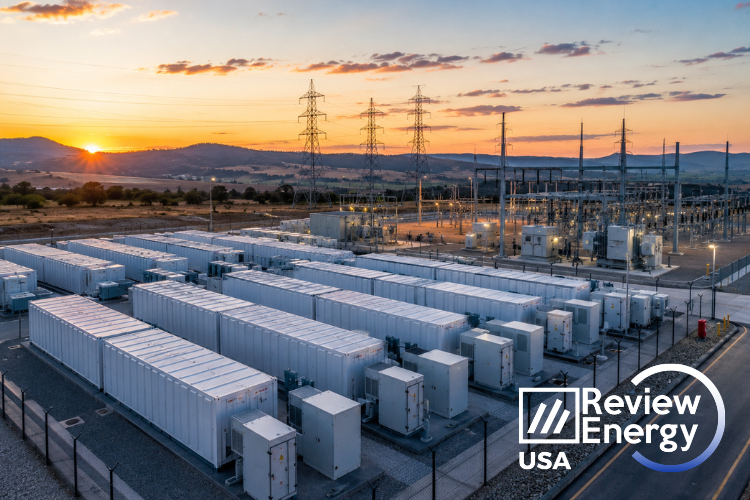


Eight-hour energy storage gains ground in California ahead of 2030
Long-duration energy storage is gaining ground in California’s power system. A new analysis by Aurora Energy Research identifies the early 2030s as an entry window for eight-hour storage systems, as the cost gap with four-hour batteries narrows and the state’s regulatory framework evolves.
The report, Beyond four hours: assessing the pathway for LDES in CAISO, examines the economic and regulatory outlook for long-duration energy storage in the market operated by the California Independent System Operator (CAISO). Aurora follows the California Public Utilities Commission’s (CPUC) definition of long-duration energy storage (LDES) as resources capable of discharging at full power for eight hours or more.
Eight-hour batteries gain ground
Aurora identifies two trends that are changing the investment case for these assets: a narrowing cost gap between four- and eight-hour batteries and increasing convergence in their wholesale market revenue opportunities.
According to the analysis, by the mid-2030s projected wholesale price spreads for four- and eight-hour systems become increasingly similar. At the same time, the CAPEX differential between the two configurations declines, improving the relative economics of longer-duration batteries.
The public version of the study does not disclose the specific percentages associated with some of these cost reductions and economic estimates, as several figures have been redacted.
Still, Aurora concludes that, from a system-cost perspective, the early 2030s present an attractive entry window, when lower costs for eight-hour lithium-ion batteries coincide with a narrower difference between the potential revenues available to four- and eight-hour systems.
California prepares 6,000 MW of new procurement
The development of LDES is also taking place against a backdrop of new procurement requirements in California.
Decision D.26-02-057, adopted in 2026, requires the procurement of 6,000 MW NQC of new clean energy and storage resources: 2,000 MW by June 2030, another 2,000 MW by June 2031, and a further 2,000 MW by June 2032.
Of that volume, at least 25% must have firm clean generation and/or long-duration energy storage attributes.
The 6 GW therefore does not correspond exclusively to long-duration storage. It covers a broader procurement of clean resources and storage, within which LDES forms part of the requirements established by the CPUC.
California had previously reserved 1,000 MW NQC for LDES within the 2,000 MW of long lead-time resources included in its Mid-Term Reliability procurement.
A regulatory change takes effect in 2027
Aurora also highlights the introduction of the Forward Charging Period (FCP) multiplier within California’s Slice-of-Day Resource Adequacy framework beginning with the 2027 compliance year.
The mechanism expands the recognized charging window for longer-duration technologies. Four-hour systems retain a 24-hour charging window, while resources with durations of eight to less than 12 hours receive 48 hours. Systems with durations of 12 to less than 16 hours receive 72 hours, with the charging window continuing to increase for longer-duration resources.
Aurora notes that the multiplier does not increase the Net Qualifying Capacity (NQC) of LDES assets. Instead, it improves how these resources can be used within the Slice-of-Day framework by recognizing charging cycles that may extend across multiple days.
CAISO already has eight-hour storage in operation
The report also identifies long-duration projects that have already begun entering California’s power system.
Tumbleweed Energy Storage, developed by REV Renewables in California, has 125 MW of power capacity and 1,000 MWh of energy capacity, equivalent to eight hours of lithium-ion battery storage. The facility began commercial operations in June 2026.
Aurora also lists three contracted eight-hour projects: Golden Fields Solar VI, with 48 MW and an expected online date of June 2027; Euismod, with 400 MW and an expected June 2028 start; and Dirac BESS, with 225 MW and an expected August 2028 start. All three use lithium-ion technology.
Together, the three contracted projects represent 673 MW of eight-hour storage expected to come online between 2027 and 2028.
Aurora compares five long-duration storage technologies
Aurora’s assessment is not limited to lithium-ion batteries. The consultancy compares five technologies for an eight-hour storage system entering service in California’s SP15 region in 2030.
Under the assumptions used in the study, CO? batteries and zinc-bromine flow batteries, alongside lithium-ion, achieve positive net present values (NPVs). By contrast, iron-air storage and advanced compressed air energy storage (A-CAES) remain uneconomic in the scenario analyzed.
In this context, a CO? battery refers to an energy storage technology that uses carbon dioxide as the working fluid to store and later release electricity; it is not a carbon capture technology.
Aurora nevertheless identifies an important distinction between the technologies evaluated: among the options compared in the study, only lithium-ion has so far been demonstrated at scale.
The analysis concludes that technology costs, project location and contracted Resource Adequacy revenues will be key factors shaping the economics of long-duration energy storage in California. Against this backdrop, the combination of declining costs and evolving capacity rules could expand the role of systems capable of shifting electricity for periods beyond four hours.


Comentarios
Sé el primero en comentar...